
Claude Fable 5.5 vs Opus 5.5: When Would Switching Pay Off?

What can we compare now?
| Decision input | Opus 5.5 baseline | Fable 5.5 candidate |
|---|---|---|
| Identity and access | Use the current documented route; verify your account | Not established by the checked sources |
| Task quality | Measure on your own accepted and failed tasks | No verified results supplied here |
| Cost and latency | Record actual charges, retries and elapsed time | Unknown until a callable route can be evaluated |
| Production role | Retain if it meets your requirements | Undecided; a version number is not an acceptance test |
The existing baseline is already harder to beat
xhigh for the reported Opus Terminal-Bench result; most other Opus results in that launch table use max. These are vendor evaluations of Opus 5.5 and Fable 5.1, not evidence about Fable 5.5, and not measurements of an EvoLink route. Anthropic also states that its production safeguards were enabled: when they intervened, cybersecurity tasks fell back to Opus 4.8, and biology or frontier-LLM-development tasks to Opus 5. Read the reported results as that evaluated configuration, not as proof that every task ran solely on Opus 5.5.medium for Opus 5.5 and high for Fable 5.1. Equal window sizes do not resolve retrieval quality; unequal defaults mean an untouched two-model test can compare different operating points.For a future Fable 5.5 evaluation, keep distinct columns for unique tasks, all attempts, first-attempt success and eventual success. A single headline percentage can hide whether a model improves routine first responses or only reaches more solutions after retries. For routing, identify the tasks Opus still fails under your actual budget; that is the set on which a premium candidate must earn its place.
Choose tasks where switching could matter
A broad “which model is smarter?” prompt rarely resolves a production choice. Start with a workload where a better result has a clear operational value. Include routine tasks too, so an improvement on a difficult example does not hide regressions on everyday traffic.
| Workload | What counts as success? | Failure worth tracking | Switching question |
|---|---|---|---|
| Multi-file code change | Required tests pass and intended behavior changes | Partial fixes, new regressions, invented APIs | Does the candidate reduce review and repair work? |
| Source-based research | Claims are supported by the supplied evidence | Unsupported conclusions or missing constraints | Does it improve accepted answers without more fact-checking? |
| Tool-driven workflow | Correct arguments and the intended final state | Wrong tool, invalid arguments, repeated side effects | Does it complete the workflow reliably? |
| Routine structured extraction | Output passes schema and field-level checks | Valid-looking but incorrect fields | Is the added cost or delay justified at this volume? |
These are proposed task categories, not claims about either model’s supported features. Only test a feature after the route documentation and a request confirm support.
Test cross-file reasoning and context use directly
Use the same fixtures for the baseline and candidate. These are proposed cases, not model outputs, and a few passes cannot establish a universal ranking.
Run a controlled comparison after access is verified
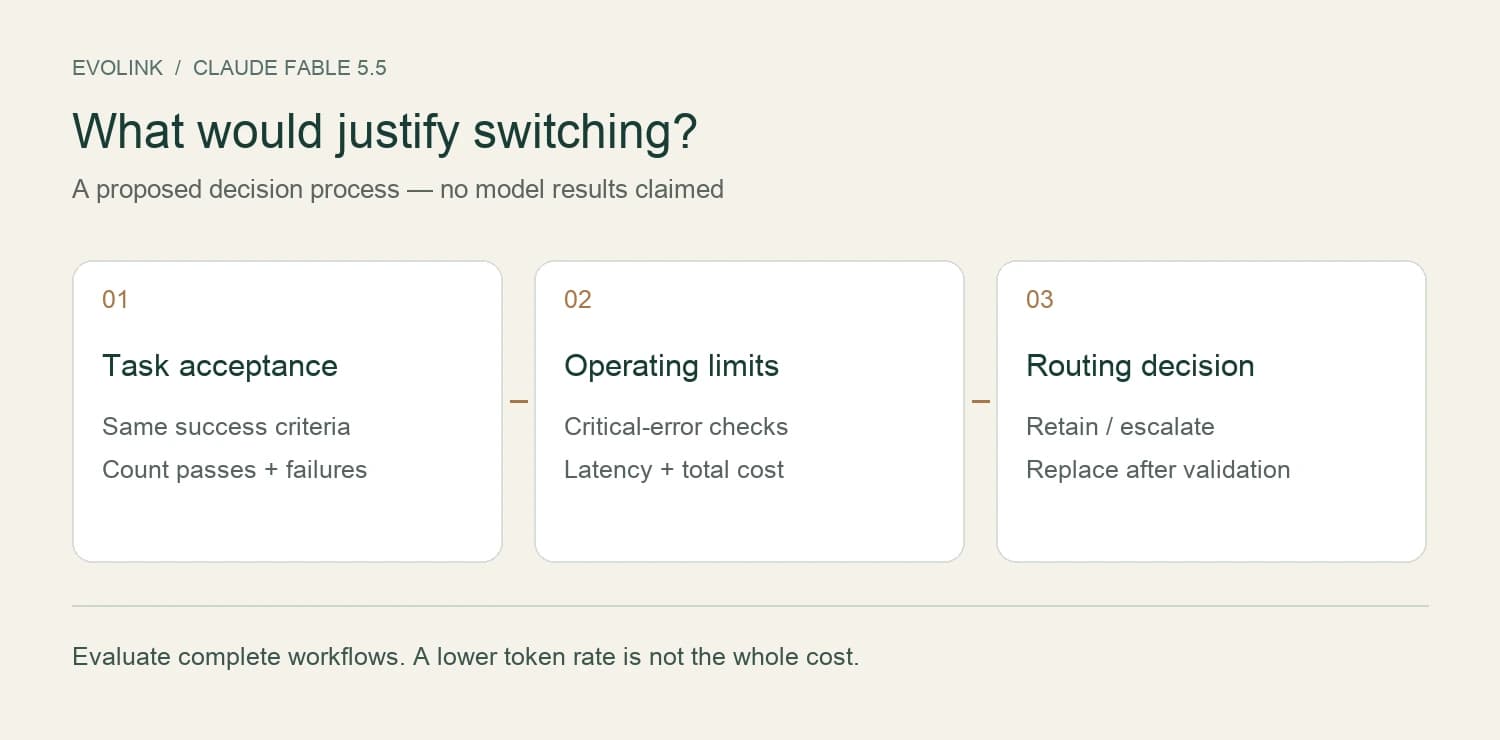
Freeze a versioned task set with expected outcomes before running the candidate. Include both Opus successes and failures; testing only known failures can make a candidate look attractive while hiding what it breaks. Separate a development set used for prompt adjustments from a held-out set used for the final decision.
Hold the input data, tool definitions, tool environment and scoring rubric constant. Record exact route IDs, dates, request settings, prompt versions and retry policy. Do not assume a setting with the same name or effort label has the same meaning across models. If each model needs different supported settings, report those settings and compare complete configurations within the same budget and latency constraints.
Repeat tasks where outputs vary. Review consequential cases without showing reviewers the model label when practical. Publish counts and denominators, not just percentages: “18 of 20 accepted” communicates the sample size. Keep a record of ambiguous judgments and do not turn a small replay into a universal performance claim.
Keep API comparisons separate from Claude Code workflow comparisons
Both experiments are useful. A workflow result answers whether your team can finish a job more effectively in its real environment. It does not isolate which part of a difference came from the model, context assembly or orchestration. If those surrounding pieces changed between runs, label the result as a configuration comparison instead of assigning the entire gain to Fable 5.5.
Compare cost per accepted task
A token rate is only one part of a workflow’s cost. Count the charges for all attempts in the evaluation window, including failures, retries, tool charges and applicable cache charges. Then divide by the number of tasks that meet the same acceptance criteria:
If no tasks pass, do not report a finite cost per accepted task. Report zero accepted tasks and the total spent. Track human review time separately unless you deliberately assign it a monetary rate and disclose that assumption.
| Evaluation ledger | Configuration A | Configuration B |
|---|---|---|
| Uncached input charges, all attempts | $3 | $4 |
| Output charges, all attempts | $5 | $6 |
| Cache read/write charges, all attempts | $1 | $2 |
| Additional tool charges, all attempts | $3 | $3 |
| Total charges | $12 | $15 |
| Tasks accepted out of the same 12 tasks | 8 | 12 |
| Cost per accepted task | $1.50 | $1.25 |
Assign each charge once. Failed attempts and retries are already inside the category totals; adding a separate “retry cost” again would double count them. Reconcile the categories against actual billing because a route’s usage fields may include cached tokens inside a larger input total. Do not apply an uncached rate to that total and then add cache charges again.
Configuration B costs more for the evaluation but less per accepted task in this example. It could still be unsuitable if it violates a hard latency limit or produces a critical error. Keep cold-start and repeat-context runs separate so warm-cache results do not disguise first-run costs.
| One-request token mix | Opus 5.5 | Fable 5.1 | Fable / Opus cost ratio |
|---|---|---|---|
| 100,000 uncached input; no cache read; 2,000 output | $0.4400 | $1.1000 | 2.50× |
| 10,000 uncached input; 90,000 cache read; 2,000 output | $0.0980 | $0.2225 | 2.27× |
| 10,000 uncached input; 900,000 cache read; 2,000 output | $0.2600 | $0.4250 | 1.63× |
(10,000 × 4 + 90,000 × 0.20 + 2,000 × 20) / 1,000,000 = $0.098. The long warm-history example narrows the ratio; it does not make Fable cheaper or include the cost of creating that cache. Real models can produce different token counts, so recalculate from the actual request mix and the applicable EvoLink route rates rather than applying 2.5× to a whole invoice.C be average total API/tool spending per submitted task, including retries, and p the share of those tasks accepted. API cost per accepted task is C / p. A candidate with cost multiplier r = C_candidate / C_Opus lowers that cost only when p_candidate > r × p_Opus. With an 80% baseline and a hypothetical 1.5× task cost, it would need more than 120% acceptance—impossible on this API-cost-only measure. It could still be worthwhile if it saves enough human work or costly failures, but those benefits need their own valuation. This is why selective escalation can make more sense than replacing every Opus request.Does using Fable only as an advisor reduce cost?
Compare three configurations on the same tasks: your current Opus workflow, Opus with a documented and available advisor pairing, and—only once verified—the candidate as the main model. For each, count the whole workflow: main-model calls, consultations, tool charges, retries and final acceptance.
Decide between retaining, escalating and replacing
Set acceptance rules before looking at candidate results. Your rules should reflect the application: a serious tool error may veto a rollout even when average quality improves. Define the maximum acceptable latency and spending, and who resolves disputed outputs.
- Retain Opus when it meets requirements and a candidate has not demonstrated a useful improvement.
- Escalate selected tasks when a verified candidate helps a recognizable difficult subset, but adds unnecessary expense or delay elsewhere. Test the routing rule itself; misclassification can erase the benefit.
- Replace a default only after quality, critical-error, latency and cost requirements hold on representative traffic, with a tested fallback.
EvoLink’s unified gateway can keep model selection in a common integration surface, but that does not make model behavior interchangeable. Check each route’s contract. Keep the candidate unset until access is verified, and review a bounded rollout before expanding traffic.
FAQ
Is Fable 5.5 better than Opus 5.5?
No verified head-to-head result is provided here. Fable 5.5 identity, access and behavior remain unconfirmed in the checked sources, so a winner cannot be established.
Should Opus 5.5 remain my default?
Keep a default that meets your requirements until a verified alternative passes your own evaluation. The right decision depends on workload outcomes, latency and total cost.
Will a larger model name or newer version imply better coding?
No. Use repository tasks with explicit expected changes and regression checks. Naming alone cannot establish success on your codebase.
Should both models use identical effort settings?
Only if the documented settings are meaningfully comparable. Otherwise record each supported configuration and compare within the same operational constraints, explaining the differences.
Can I decide using token prices alone?
No. Retries, output length, tools, cache behavior and failed tasks can change the total. Compare actual charges per accepted task with the same success definition.
What if the candidate wins only on difficult tasks?
Consider a selective escalation route after access and behavior are verified. Include the cost and errors of deciding which requests to escalate.
Is this an EvoLink performance benchmark?
No. No authenticated Fable 5.5 call was made for this article. The task matrix, protocol and arithmetic example are evaluation aids, not measured model results.
Where should I check release status?
Sources and scope
- Anthropic model overview: documented-model guidance and identity check.
- Anthropic news: release evidence check.
- EvoLink Opus 5.5: current product and pricing reference.
- Claude Code advisor documentation: advisor context, additional usage and cache behavior; not evidence of Fable 5.5 support.