
Claude Fable 5.5 Release Date: Facts vs Rumors

What is confirmed about Fable 5.5?
| Question | Status on October 3, 2026 | What would resolve it? |
|---|---|---|
| Has an official Fable 5.5 release date been announced? | Not found in the checked sources | A dated Anthropic announcement naming the model |
| Is there an official API model ID? | Not found in the checked model overview | A documented identifier and access conditions |
| Are price and context limits confirmed? | Not established for Fable 5.5 | Documentation for the exact released model |
| Can EvoLink users call it? | Unverified; no authenticated request was performed for this article | A verified EvoLink route, account access and successful request |
| Is it a drop-in Fable 5.1 upgrade? | Not established | A documented contract plus workflow replay |
This is a scoped source check, not proof that no private testing exists. It also does not establish that the prospective model will use this name. A listed Fable 5.1 specification therefore cannot tell you what a prospective Fable 5.5 request would support.
Why are people expecting Fable 5.5 now?
Two different stories have become intertwined: Anthropic is releasing its 5.5 family, and users are attributing changes in Fable sessions to a hidden successor. The first has official dates. The second does not identify a verified Fable 5.5 backend.
| Date in 2026 | What the source actually establishes | What it does not establish |
|---|---|---|
| September 1 | Anthropic introduced Fable 5.1 and Mythos 5.1 | A schedule for another Fable release |
| September 22 | Opus 5.5 launched; its announcement named Sonnet 5.5 and Haiku 5.5 as forthcoming | A Fable announcement: that forward-looking sentence did not name Fable |
| September 28 | Sonnet 5.5 launched | A requirement that every Claude tier adopt 5.5 at the same time |
| October 1–2 | Kingy's source review traces an unofficial next-week/Tuesday prediction and a later repost | An official October 6 release date or a second independent confirmation |
| October 3 | Our check of the news index and model overview still finds Fable 5.1 as the documented Fable | Proof that private testing cannot exist |
The October 6 date is therefore a prediction to trace, not a date to schedule against. We could not independently reopen the original X posts in this check; the prediction row is attributed to Kingy's review. Its publication chronology is not our verification of the underlying claim. Earlier discussions also used “Fable 5.2”; a shared release window is insufficient to establish that 5.2 and 5.5 name the same model.
There is a practical consequence for API buyers. Sonnet and Opus announcements explain why the name looks plausible, but they do not turn an aggregator's dated catalog entry into an Anthropic release. Keep the date a page was created separate from the date the vendor actually announces a model.
Which signals should change your plans?
An official announcement can establish a name or schedule, but its scope matters. A consumer-product release, limited partner access and a public API release may have different conditions. Read the access language before interpreting “available” as available to your account.
A reseller page can be useful for discovering a potential route. It does not independently prove the upstream model’s identity, and its commercial claims need checking against the exact service offered. A model saying “I am Fable 5.5” is also insufficient identity evidence. Responses can repeat instructions or supplied text; a different writing style is not an API contract.
Similarly, a UI accepting a Fable-shaped identifier is not enough to establish what served the request. Record the channel and request, then check documented identity and response metadata. A memory quiz, claimed training cutoff or unusually good answer cannot substitute for that evidence.
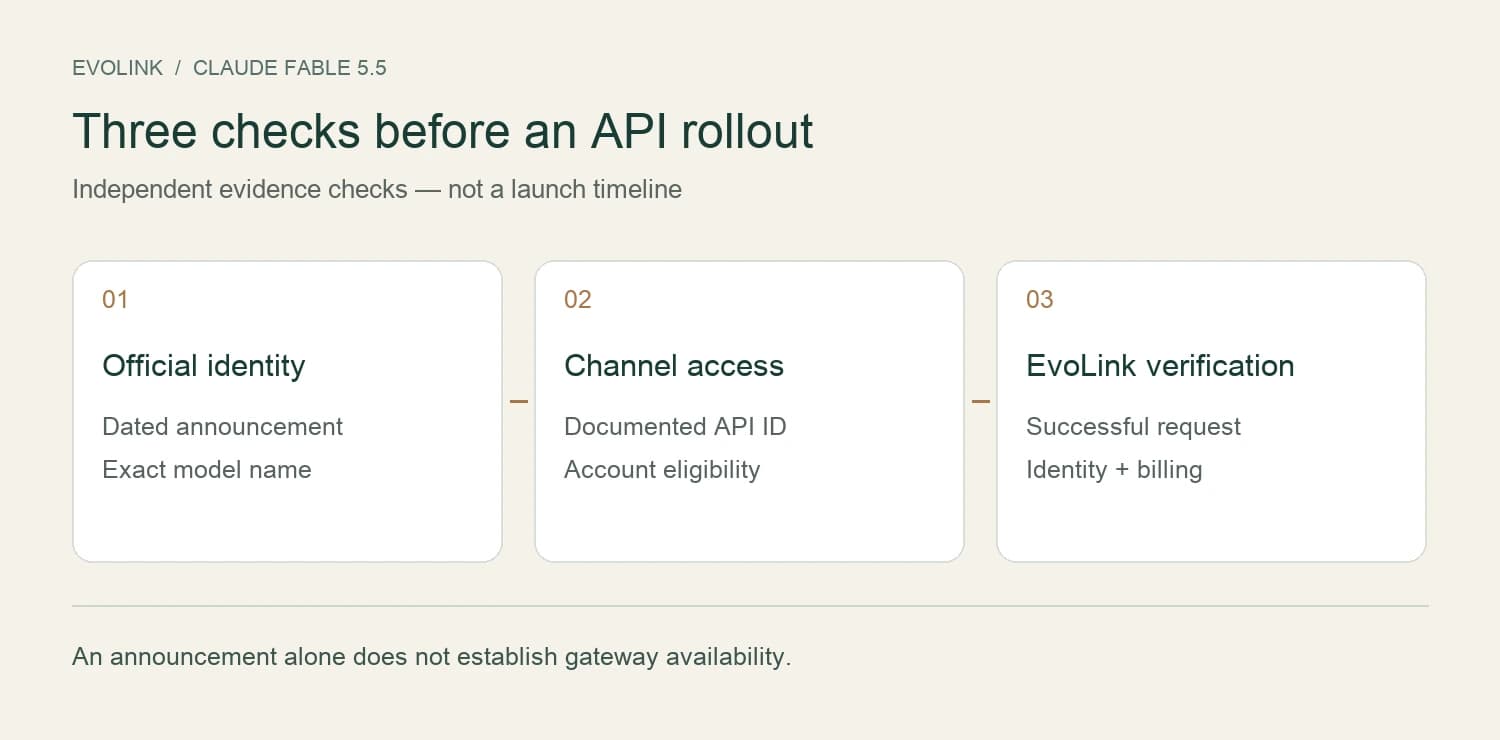
Use three separate milestones:
- Official identity: a dated announcement or model documentation names the release and its scope.
- Channel access: the intended API channel documents the identifier, eligibility, parameters and billing terms.
- EvoLink verification: the route and account access are checked, a request succeeds, and identity and billing evidence agree with the documented route.
Does an animation demo mean a new video-generation API?
For a team evaluating an animation workflow, separate three deliverables: the code or scene instructions produced by the language model, the frames rendered by another tool, and the audio produced or supplied elsewhere. A final MP4 proves that a workflow produced a file; it does not by itself identify the model, the number of attempts or which component produced each part.
Ask for the original task, generated source or scene file, tool versions and render settings, and a record of retries and manual changes. Then change one requirement—such as camera timing or an object's material—and check whether the source can be revised and rendered again. This tests the reusable artifact an application would buy, rather than treating one attractive clip as evidence of a new video endpoint. The model attribution remains a separate question.
Should you wait for Claude Fable 5.5?
Are you waiting for better reasoning or more usable time?
| Your actual constraint | Check now | What a Fable 5.5 announcement would still leave unresolved |
|---|---|---|
| You hit a subscription limit while answers are good enough | Current plan terms, when work is interrupted and how much useful work completes | Whether the new model is included and how its usage counts |
| API spending exceeds the project budget | Charges per completed task, repeated context, retries and tool expenses | The new route’s applicable rates and measured workflow cost |
| Opus fails a particular reasoning task | Save the failing trace, expected result and review effort | Whether a verified candidate fixes it without breaking current successes |
| You cannot deliver without a currently missing capability | Identify the required behavior and a present alternative | Whether the released model and your access channel actually support it |
What can you prepare before a release?
Create a baseline record with the task input, expected result, current route, prompt and tool versions, settings, pass/fail reason, elapsed time and total charges. Include a difficult case, a routine case and a case where a plausible answer would still be wrong. Keep credentials and personal data out of shared examples.
This preparation remains useful if the release is delayed, renamed or never materializes. It gives your team a concrete definition of improvement without betting a delivery date on a rumor.
FAQ
Has Claude Fable 5.5 been released?
An official release was not established by the news index and model overview checked on October 3, 2026. This article does not claim to rule out private testing or unlisted access.
What is the Claude Fable 5.5 release date?
No official date was found in the checked sources. A date repeated by third parties remains unconfirmed without a primary source establishing its scope.
Is Fable 5.5 the same as a rumored Fable 5.2?
That relationship has not been established. Do not merge names, IDs or specifications without official evidence connecting them.
Do screenshots prove a hidden rollout?
A screenshot can motivate further checking, but it does not independently establish the exact model, account eligibility or a public API release. Seek documentation and verifiable route evidence.
What will Fable 5.5 cost?
No verified Fable 5.5 rate is available from the sources checked here. Existing Claude prices are useful for a current baseline, not a forecast of new-model pricing.
Can I use Fable 5.5 through EvoLink now?
EvoLink access is unverified in this release check. Consult the linked API availability page; this article supplies no executable model ID or access promise.
Should I change my Claude subscription because of this rumor?
Do not assume an unannounced model will be included in a particular subscription. Evaluate a plan against its documented current access and your actual usage; API access and subscription access need separate confirmation.
What evidence will change this article?
A dated official announcement or model entry can update release status. EvoLink availability requires its own route, access and billing checks. Performance conclusions additionally require a disclosed evaluation.
Sources and update record
- Anthropic news: checked for an official Fable 5.5 announcement.
- Anthropic model overview: checked for naming, API identity and access information.
- EvoLink Fable 5.5 availability: the separate gateway-access status page.