GPT Image 2.6 Leak: OpenAI’s Docs and Anonymous Model Clues
What OpenAI’s markup documentation says, and what Aurora and Shooting Star sightings do—and do not—tell us about GPT Image 2.6.
 EvoLink TeamProduct Team
On this page
markup parameter describes support for both GPT Image 2.5 and 2.6. That is a concrete clue about the name and an editing interface, but it is not a public model launch: as of October 29, 2026, OpenAI's model catalog and API changelog do not list a 2.6 release or public model ID. Image edit reference, model catalog, API changelogMeanwhile, people have shared images from experimental models called Aurora and Shooting Star. Some look promising, but OpenAI has not identified either as GPT Image 2.6. Their samples are useful for seeing what testers are trying; they cannot establish 2.6's performance, price or launch date.
What is confirmed about GPT Image 2.6?
markup to image-editing specifications. The same description appears in the online API reference and names both 2.5 and 2.6 as supported versions.| Question | What is known as of October 29 |
|---|---|
| Has the name appeared in official documentation? | Yes, in the image-editing markup description. |
| Is there a public API model ID? | No 2.6 ID is listed in the checked public model catalog or image-edit reference. |
| Is there an official launch date or price? | Neither was found in the checked official sources. |
| Is Aurora or Shooting Star confirmed as 2.6? | No official mapping has been published. |
| Is it available on EvoLink? | The EvoLink 2.6 page is a coming-soon page, not a live API listing. |
The absence of an entry in the sources checked does not describe access held by every private tester. It does mean a guessed model ID or a third-party claim should not be treated as an official integration contract.
What does the new markup parameter do?
markup as a transparent PNG overlaid on the first input image to guide an edit. The overlay must contain transparent pixels and match the image's dimensions after orientation. It can be supplied by file ID, HTTPS URL or base64 data URL, and it cannot be combined with mask in the same request. OpenAI image edit reference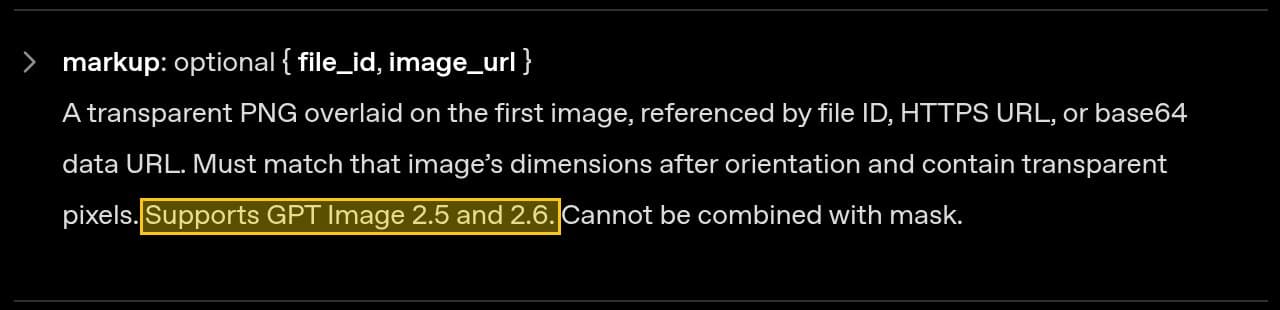
Aurora and Shooting Star: what the samples show
Aurora appeared in a model list and in Arena images
aurora-red-alpha, aurora-green-alpha and aurora-blue-alpha in an OpenAI model list on October 18. Its author said they inspected the list rather than successfully calling those models. A listing by itself says little about access, quality or cost.Shooting Star samples are not a confirmed 2.6 benchmark
shooting-star-red-alpha and shooting-star-green-alpha. Some attributed them to OpenAI based on the images or third-party analysis, but the discovery material did not identify a confirmed provider. No public source maps those labels to 2.6. Community discoveryGPT Image 2.6 vs 2.5: what can actually be compared?
xhigh and max quality settings; the current image-edit reference accepts up to 16 input images and describes transparent output for 2.5. OpenAI image generation guide, image edit referencemarkup description includes 2.5. Until OpenAI publishes a 2.6 model card and testable access, there is no verified basis for saying that 2.6 adds 4K output, supports more reference images, fixes text rendering, or is faster than either 2.5 model.For anyone evaluating an image model, the useful comparison is a set of repeatable tasks: preserve a product's identity through several edits, render the same short and dense text, count and place multiple objects, and measure total time and cost including retries. A single impressive picture cannot answer all of those questions.
Availability and pricing
Frequently asked questions
When will GPT Image 2.6 be released?
No official date was found in the sources checked on October 29. Posts predicting an imminent launch are speculation, not a schedule from OpenAI.
Can I call GPT Image 2.6 in the API now?
Is markup the same as a mask?
mask. It does not fully explain how every type of visual annotation is interpreted.Is Shooting Star or Aurora GPT Image 2.6?
There is no official confirmation linking either experimental name to 2.6. Public samples should retain the labels under which they were shared.
Is GPT Image 2.6 better or cheaper than 2.5?
There is not enough verified public information to answer either question. Performance, price and release status need to be established separately when OpenAI publishes them.