GPT-6.1 Terra vs GPT-6.1 Sol: Which Should You Use?
Compare GPT-6.1 Terra and Sol by coding, data analysis, reasoning effort, benchmark costs, and the tasks each model may fit.
Himi LiProduct Manager at EvoLink
9 min read
On this page
Choose GPT-6.1 Terra for work with a clear scope: screen-based tasks, writing from supplied material, and small code fixes. Keep GPT-6.1 Sol for complex coding and projects where a missed dependency creates expensive rework.
Terra has the lower Standard API token rates. The harder question is whether a particular Terra setting delivers enough quality for your task. Increasing its reasoning effort can change both the bill and the wait, so “Terra or Sol?” is also a configuration decision.
GPT-6.1 Terra vs GPT-6.1 Sol at a glance
Decision variable
GPT-6.1 Terra
GPT-6.1 Sol
Best starting point
Defined screen tasks, supplied-material writing, scoped fixes
Complex coding and connected professional work
Standard input / output, per 1M tokens
$1 / $5
$2 / $10
Cached input, per 1M tokens
$0.05
$0.10
Reasoning effort
none, low, medium, high, xhigh, max
low, medium, high, xhigh, max
Default effort
medium
medium
Tool calling
Responses API required
Responses API required
Official API rates and specifications: Terra, Sol, pricing. Rates shown are OpenAI Standard rates; long-context and other service modes have separate conditions.
Both accept text and images, return text, and list a 1,050,000-token context window with up to 128,000 output tokens. A larger-context argument does not separate them. OpenAI’s Terra reference and Sol reference document those shared limits.
Which is better for coding, computer use, and data analysis?
Coding: Terra for the bounded fix; Sol for the connected project
A broken layout with clear reproduction steps is a reasonable Terra candidate. A feature spanning authentication, billing, and shared state gives Sol a stronger case: the cost of missing a relationship can outweigh the token-rate difference. This task split follows OpenAI’s model-selection guidance.
The independent evidence supports keeping the distinction. Artificial Analysis reports a Coding Agent Index v2.0 score of 48 for Terra and 54 for Sol. That index combines repository changes, terminal tasks, and repository questions. A single terminal benchmark cannot stand in for the entire coding job. AA release analysis; index methodology.
There is also an exception worth keeping: OpenAI reports that Terra at max effort surpasses Sol on Terminal-Bench-Science 0.1 at lower cost, while still recommending Sol or Astra for the most complex coding. Scientific terminal workflows and a large application refactor are different tasks. OpenAI’s launch evaluation.
Computer use and writing: Terra is a sensible first candidate
Terra is worth trying for workflows such as reading an invoice and entering fields into an application. OpenAI's visual understanding and computer-use evaluations show how it performs on these kinds of tasks. Source: OpenAI.
Terra is also worth trying when the facts are supplied and the deliverable is clear: turn release notes into customer documentation, or revise a proposal for a defined audience. If the job requires reconciling conflicting evidence across a complex project, Sol remains the more cautious starting choice. OpenAI’s selection guide.
Data analysis: the difficult questions can justify Sol
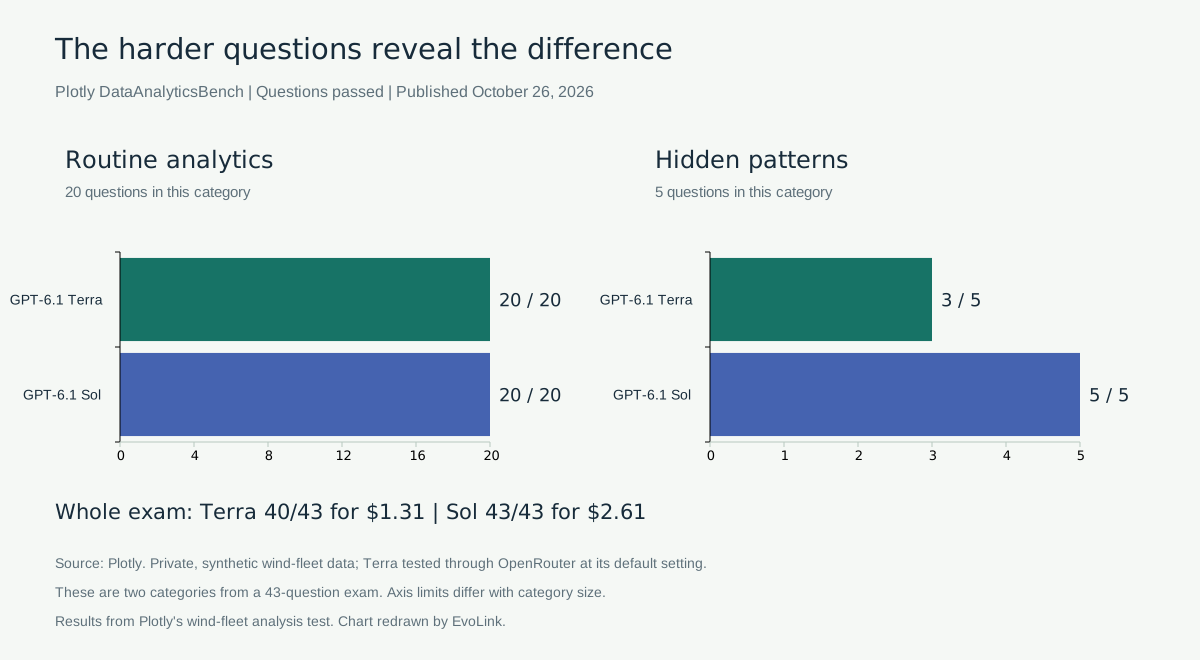
Plotly’s 43-question data-analytics exam gives a concrete example. Terra passed 40 questions for $1.31; Sol passed all 43 for $2.61. Both answered all 20 routine analytics questions correctly. The gap appeared in harder categories, including hidden patterns: Terra found three of five, Sol five of five. Plotly’s original results.
Plotly results: Terra and Sol both pass 20 of 20 routine analytics questions; Terra finds 3 of 5 hidden patterns and Sol finds all 5.
Routine questions and hidden-pattern questions can lead to different model choices. Original redraw of Plotly’s published results.
That makes Terra a plausible choice for recurring, well-defined queries, and Sol worth considering when the task is to discover something the question did not name. The exam used private synthetic wind-fleet data; Terra ran through OpenRouter at its default reasoning setting, with heavy cache reuse. Test conditions; benchmark design.
Terra high vs Sol medium: which effort setting makes sense?
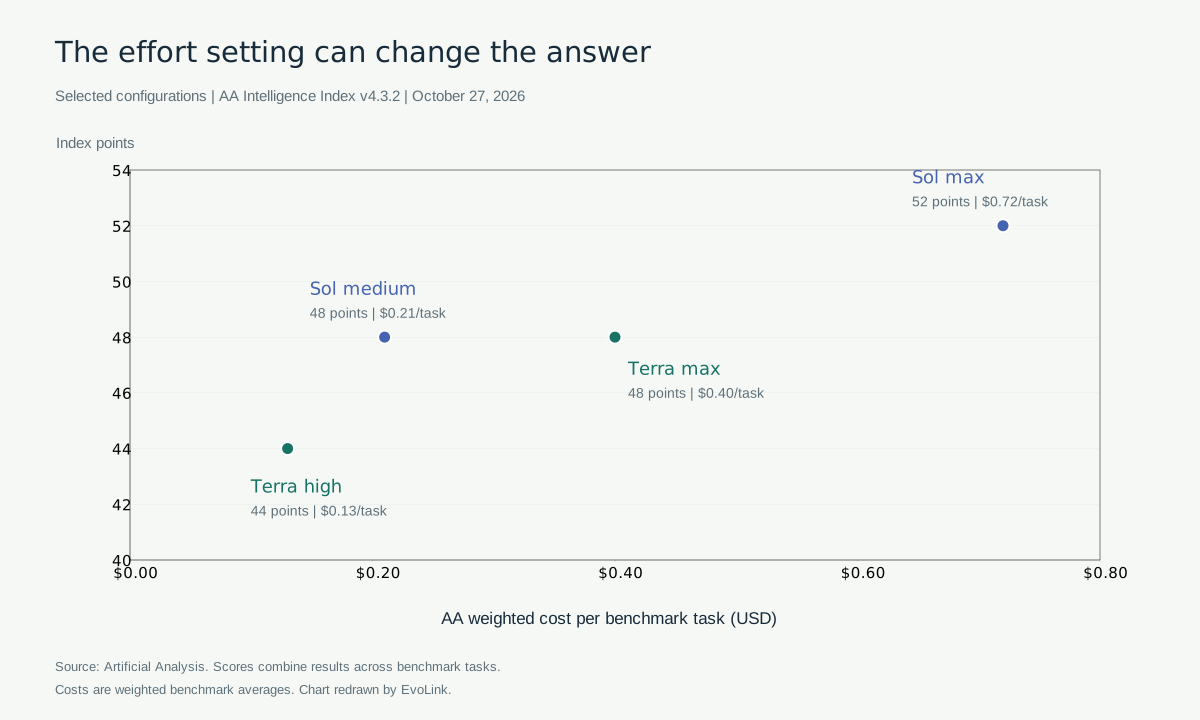
Terra high is the cheaper configuration in AA’s comparison, but Sol medium has the higher composite score.
Model and effort
AA Intelligence Index
AA weighted cost per benchmark task
GPT-6.1 Terra · high
44
$0.13
GPT-6.1 Sol · medium
48
$0.21
GPT-6.1 Terra · max
48
$0.40
GPT-6.1 Sol · max
52
$0.72
October 27, 2026 snapshots: AA provider leaderboard and max vs max. Index values are composite points, not task pass percentages. Costs are weighted averages across benchmark tasks.
Selected AA configurations: Terra high scores 44 at 13 cents per benchmark task; Sol medium scores 48 at 21 cents; Terra max scores 48 at 40 cents; Sol max scores 52 at 72 cents.
Terra max and Sol medium both display 48, yet their component results differ: Terra max scores 56% versus 48% on Terminal-Bench 4.0, while Sol medium leads 63% to 60% on AutomationBench-AA. Matching a rounded aggregate is not proof that the settings will produce the same result on your task. Terra max results; Sol medium results.
AA also identifies different efficient configurations for different objectives: Terra low and medium sit on its general intelligence-versus-cost frontier; low and xhigh sit on its coding frontier. A blanket rule to always use medium, or always avoid higher effort, loses that distinction. AA’s analysis.
Is Terra actually faster and cheaper than Sol?
Measure output speed and the wait for the first answer
Artificial Analysis reports output speed and time to first token separately for each model configuration and provider. These measurements change over time, so check the current figures for the endpoint you plan to use. AA provider leaderboard.
For an interactive assistant, first-answer latency matters. For an agent completing several tool steps, measure when the result is actually saved or delivered. AA’s performance definitions distinguish those measures; its comparison page also includes a calculated 500-token response time, which should not be read as the duration of a real coding or desktop job.
In Plotly’s 43-question DataAnalyticsBench, median wall-clock time from question to final answer, including queries, was 15 seconds for Terra and 18 seconds for Sol. Terra answered 40 questions correctly and Sol 43; the benchmark used a private synthetic wind-fleet dataset, and Terra ran through OpenRouter at its default reasoning setting. Plotly results; Terra test conditions.
Lower token rates do not settle the cost of getting the work done
At the same Standard billable token counts, Terra’s input and output charges are half Sol’s. Once effort changes token use, the ratio changes too. At max effort, AA lists $0.40 versus $0.72 per benchmark task, approximately 44% less for Terra. In the cross-effort comparison, Sol medium is cheaper than Terra max. Official rates; AA max/max; AA provider leaderboard.
AA calculates its task cost using weighted evaluation averages and token charges. That is a different denominator from a production task your team has accepted. AA cost definition. For an application, use:
Cost per accepted task = total model and tool spend, including failed attempts ÷ number of accepted tasks
Track human review time alongside it. A cheaper answer that needs repeated correction may be a poor trade; a scoped task Terra completes cleanly may be an attractive one. The relevant saving depends on how often the workflow reaches an acceptable result.
Should you switch, keep Sol, or use both?
Move a defined class of work before changing your whole workflow. These are the starting choices suggested by the evidence above:
Your work
Starting choice
What would change the choice?
A reproducible, localized code fix
Evaluate Terra
Repeated scope mistakes or missed regressions favor keeping Sol
A feature or refactor across unfamiliar files
Keep Sol as the baseline
Terra earns a place when it handles the dependencies reliably
Screens, forms, and material-based drafting
Evaluate Terra
Incorrect saved fields or missing supplied facts require a stronger route or clearer input
Recurring analytics with known questions
Evaluate Terra
Hidden-pattern discovery and harder analytical questions give Sol a stronger case
A workflow already running well on Sol
Retain it while trying a scoped Terra candidate
Switch when acceptable outcomes justify the change in cost and waiting time
A mixed setup can make sense: use Terra on the task classes it handles well and keep Sol for harder work. Escalation needs a dependable signal, such as failed tests or a required field missing from a saved record. A model reporting that it is confident is not the same as a verified result.
For a first comparison, give both models the same representative input and acceptance criteria. Change effort separately from the model so you can see what caused a difference. Then choose a model-and-effort pair that meets the quality and response-time requirements at an acceptable cost.
Check the route as well as the model
EvoLink’s unified API gateway brings model selection into a shared integration. Review the GPT-6.1 Sol page and the GPT-6.1 Terra availability page for current access and rates. Before moving production work, confirm that your chosen route supports the tool workflow you need.
Frequently asked questions
Is GPT-6.1 Terra better than Sol for coding?
Sol has the higher AA composite coding score. Terra remains a candidate for scoped fixes and certain terminal workflows; OpenAI also reports a Terra advantage on its scientific terminal evaluation. The kind of coding task matters. AA; OpenAI.
Is Terra high equivalent to Sol medium?
No fixed equivalence is established. AA’s snapshot gives Terra high a lower composite score and lower average benchmark cost. Even Terra max matching Sol medium’s displayed aggregate does not make their task-level results identical. AA provider leaderboard; Terra max results; Sol medium results.
Can both models use the same tool-calling API?
OpenAI documents Responses for tool calling on both models. Check your channel’s support as well; an official model capability does not establish that every gateway or client passes it through. Terra API reference; Sol API reference.

 Himi LiProduct Manager at EvoLink