GPT-6.1 Terra vs Claude Opus 5.5: Is Opus Worth the Extra Cost?
Compare GPT-6.1 Terra and Claude Opus 5.5 on task costs, coding, automation, and switching an agent.
 Himi LiProduct Manager at EvoLink
On this page
Can GPT-6.1 Terra replace Opus 5.5?
For an existing Opus user, the useful question is therefore specific: which jobs can move to Terra without increasing correction work enough to erase the saving? That can be a substantial subset without being the entire application.
Is Terra four times cheaper—or nine times cheaper?
Both numbers can describe published comparisons, but they have different denominators. Terra's listed standard rates apply to requests with up to 272,000 input tokens; higher long-context rates apply above that threshold.
| Cost comparison | Result | Scope |
|---|---|---|
| Official standard API token rates | Terra's input and output rates are 75% lower: $1/$5 versus $4/$20 per million tokens | Model charges for the same token counts |
| OpenAI's Agents' Last Exam experiment | OpenAI reports roughly ninefold lower task cost for Terra at max effort versus Opus 5.5 | OpenAI's computer-use evaluation |
| AA's selected max configurations | Weighted Intelligence Index task cost is $0.40 for Terra and $5.98 for Opus with default fallback—about a 15-fold difference | AA's weighted average benchmark-task cost |
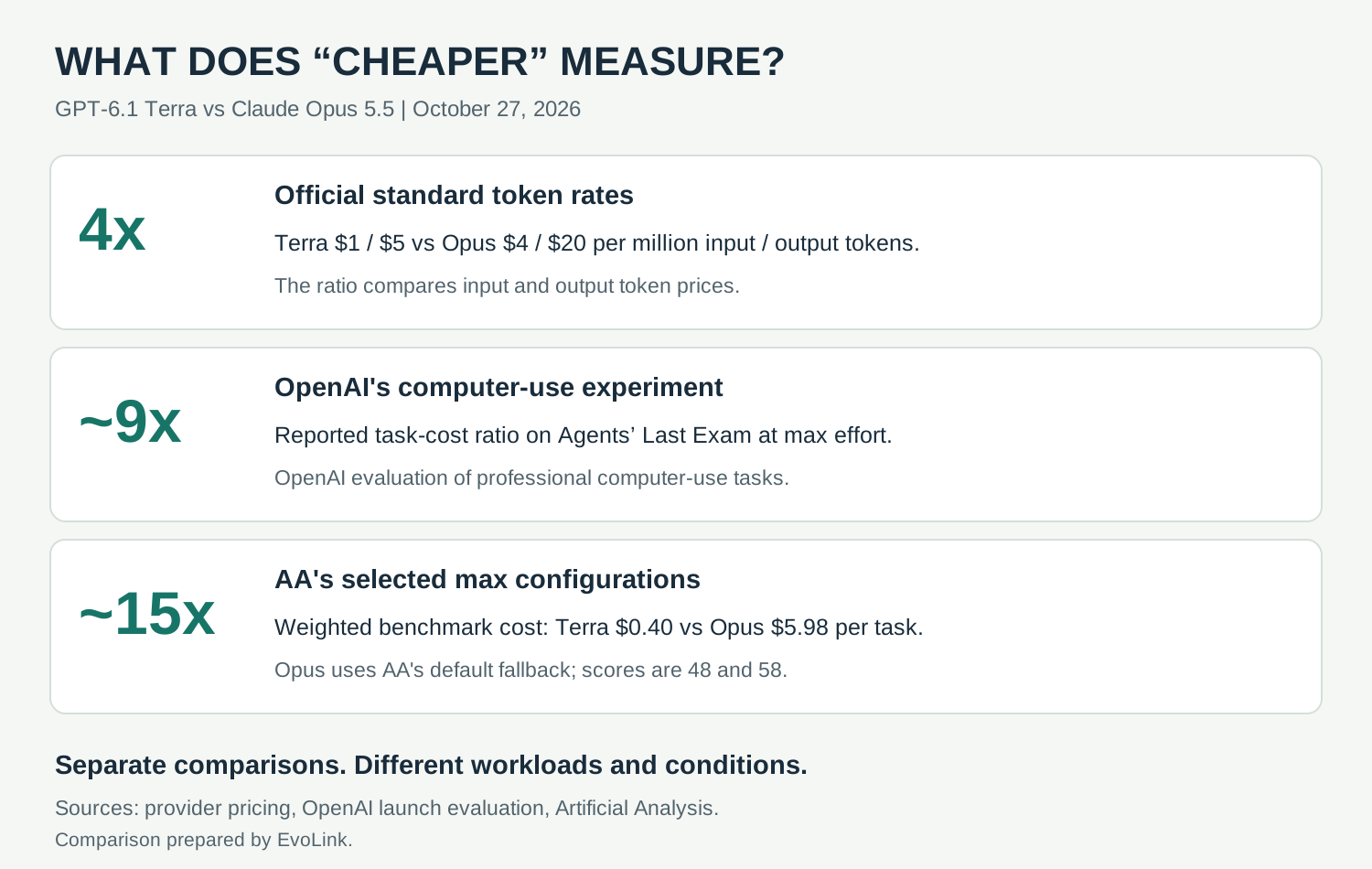
OpenAI's ninefold figure comes from its professional computer-use evaluation. Costs for other tasks depend on token use, tool calls, and retries.
For production, count the complete model and tool bill across attempts, then divide by the number of accepted results. Track human review time alongside the bill. A lower token rate helps most when the workflow reaches an acceptable result without repeated intervention.
Where is Opus worth paying more for?
AA's same-evaluator comparison supplies a more useful starting point than combining each vendor's headline score:
| AA result, selected max configurations | Terra | Opus, default fallback |
|---|---|---|
| Intelligence Index | 48 | 58 |
| Terminal-Bench 4.0 | 56% | 60% |
| AutomationBench-AA | 60% | 70% |
Opus leads on these measures, with a different margin for each task set. It is a strong baseline for difficult coding and connected agent workflows.
EvoLink self-test: a pelican riding a bicycle
In EvoLink's pelican-on-a-bicycle test, GPT-6.1 Terra is on the left and Claude Opus 5.5 is on the right.
These are example outputs, not a controlled benchmark; they do not establish general coding quality or cost advantages.
When does Terra make more sense for automation?
What about long documents, analysis, and writing?
For writing from a complete brief—such as turning release notes into customer documentation—Terra is a sensible candidate because the supplied facts and omissions can be checked. For analysis that must reconcile contradictory documents, Opus's broader evaluation results justify keeping it as the initial baseline.
If prose or analytical style matters to you, try both models on your own documents and compare the results and editing needed.
Can you switch an existing Claude agent to Terra?
gpt-6.1-terra and claude-opus-5-5. Changing the name does not by itself adapt the API's tool messages, reasoning controls, conversation state, or cache policy.Three differences matter for an agent:
- Reasoning and tool controls. Terra supports
nonethroughmax, defaults tomedium, and requires the Responses API for tool calling. Opus uses adaptive thinking that cannot be disabled, also defaulting tomedium. Its native API has restrictions on forced tool use. Shared effort labels do not mean equal computation. Terra reference; Opus reference; Claude effort guide. - Conversation history. Anthropic documents model- and conversation-specific constraints on thinking blocks. A long-running Claude conversation needs deliberate handling when changing models; do not assume its complete internal history can simply be replayed to another provider. Opus behavior changes.
- Caching. At the providers’ Standard API rates, cache reads cost $0.05 per million tokens for Terra and $0.20 for Opus. Terra cache writes cost $1.25 for 30 minutes or $2.50 for 12 hours; Opus writes cost $5 for 5 minutes or $8 for one hour. These are per-million-token prices, and the different lifetimes affect reuse and rewrites. Terra rates apply to requests with up to 272,000 input tokens. OpenAI pricing; Anthropic caching prices.
A coding application also contributes its own tools, context handling, and orchestration. Choosing a base model does not establish that an existing Claude Code or other client setup supports it. Likewise, API rates do not describe the value or usage allowance of a subscription plan.
EvoLink's unified API gateway is relevant when you want to manage model choices through a shared integration. Confirm the route's endpoint, tool support, reasoning controls, and actual billing before moving an agent workflow. Provider documentation establishes native capabilities; gateway support needs its own verification.
Which work should you move first?
If Opus already handles your hardest coding and analysis reliably, retain it there. Terra's most useful first role is a clearly defined task class whose results can be checked without asking another model to guess whether it succeeded.
For example, keep Opus responsible for a repository-wide change while considering Terra for a separate, reproducible UI fix. In an operations workflow, consider Terra for known form fields while retaining the stronger route for an exception that needs investigation. Escalation should follow an observable failure or unresolved requirement, rather than confidence language alone.
The decision is whether the lower-cost route completes enough of that work reliably to justify using it. The evidence supports selective substitution and explicit routing much more strongly than a blanket claim that Terra replaces Opus.
Frequently asked questions
Is GPT-6.1 Terra an Opus 5.5 replacement for coding?
Terra is a good candidate for scoped fixes. Use Opus as a baseline for complex coding and multi-step agent workflows.
Does the ninefold cost claim mean Terra delivers the same quality?
No. It is OpenAI's task-cost claim for a specified computer-use evaluation. It does not establish equal quality, equal settings across providers, or the same saving on another workload.