
GLM-5.4 Release: Architecture, Benchmarks, API Status, and How to Test It
Zhipu opened GLM-5.4 to Coding Plan users on Nov 23, 2026. Review its Loop Transformer architecture, 51.1% win rate vs GLM-5.3, API status, and 3-task test guide.
 Himi LiProduct Manager at EvoLink
On this page
Max effort setting. Before switching production workflows, run a controlled test on tasks with clear pass/fail criteria, and verify routing, billing, and compatibility separately once standard API access opens.GLM-5.4 Release Overview (TL;DR)
| Specification | Details (as of November 24, 2026) |
|---|---|
| Release Date | November 23, 2026 (Coding Plan rollout) |
| Architecture | Loop Transformer (~750B GLM-5 base; 28 weight-sharing layers running 2 loops) |
| Context / Max Output | 1M token context (ZCode auto-compresses at ~966K) / 128K max output |
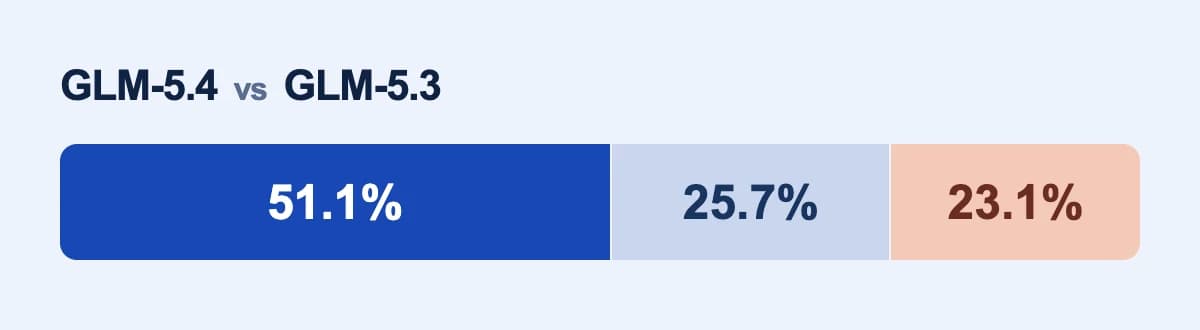
| Internal Benchmark | 200 coding tasks vs. GLM-5.3: 51.1% win, 25.7% tie, 23.1% loss |
| Token Quota | ~1.5x token allowance vs. GLM-5.3 for eligible weekly-quota users |
| API & Model Weights | Pay-as-you-go API pending security review; weights planned after further hardening |
| EvoLink Status | Pending integration (model ID, endpoints, and pricing TBD) |
Where to Access GLM-5.4: ZCode, Claude Code, and API Status
- ZCode: If GLM-5.4 does not appear, update the client and refresh the model list in Settings. ZCode offers three thinking effort levels—
Low,High, andMax—withMaxenabled by default. - Model IDs: Use
glm-5.4in other supported tools, andglm-5.4[1m]in Claude Code. - Context Compression: While Zhipu lists a 1M token context window and a 128K max output, ZCode automatically compresses context at roughly 966K tokens. Factor this client-side threshold into long-running tasks. ZCode FAQ
GLM-5.4 Architecture: How Loop Transformer Works
- First pass: Builds initial representations.
- Second pass: Refines those representations, reusing selected KV caches and sparse attention indices while maintaining its own local sliding-window cache.
GLM-5.4 Benchmarks (vs. GLM-5.3) and 1.5x Quota Explained
51.1% Win Rate Against GLM-5.3
What the 1.5x Token Quota Means in Practice
Early Developer Feedback: Latency, Errors, and Effort Levels
Community reports during the first 48 hours highlight varying latency and stability across environments:
- A Hermes Agent user reported waiting roughly 10 minutes for a response to a short prompt on
Maxeffort. Hermes Agent report - Users on LINUX DO noted long wait times and frequent reconnections. Linux DO speed thread
- A Reddit user encountered direct capacity errors. Capacity discussion
Max, Zhipu officially recommends dropping the Effort setting by one level for small, well-scoped edits. ZCode guidanceMultimodal Coding Boundaries and Real-World Cases
Two early community cases illustrate what GLM-5.4 currently delivers:
- Unity River Generation: Reddit user
NullzeroJPstruggled to follow text-only explanations of river-generation logic and proposed changes. After asking GLM-5.4 to render the existing logic and proposal as an SVG diagram, he was able to give targeted feedback on the diagram and turn the direction into an implementation spec. At the time of posting, the actual code fix was still in progress. Unity developer’s original comment - Browser 3D Prototype: Reviewer Woyin AI reported that GLM-5.4 generated a runnable Three.js scene of a pelican riding a bicycle. However, the background moved backward while the rider stayed fixed at the origin, and several parts clipped through each other. When verifying 3D prototypes, inspect static frames, motion logic, and geometry separately. Creator’s walkthrough (Chinese)
How to Evaluate GLM-5.4: A 3-Task Testing Framework
Before testing, lock your commit hash, prompts, tools, permissions, and run budget. Define pass/fail criteria upfront, and log the model, channel, effort level, retries, manual edits, total time, and token usage.
Hands-On Test: Fixing a Floating Support Widget Overlap
390 px mobile viewport, a customer support floating widget overlaps part of the checkout button. Provide the broken screenshot and component source code to GLM-5.4 with the following constraints:- Make both buttons fully visible and clickable.
- Preserve the existing
Tabfocus order. - Restrict changes to the checkout page layout.
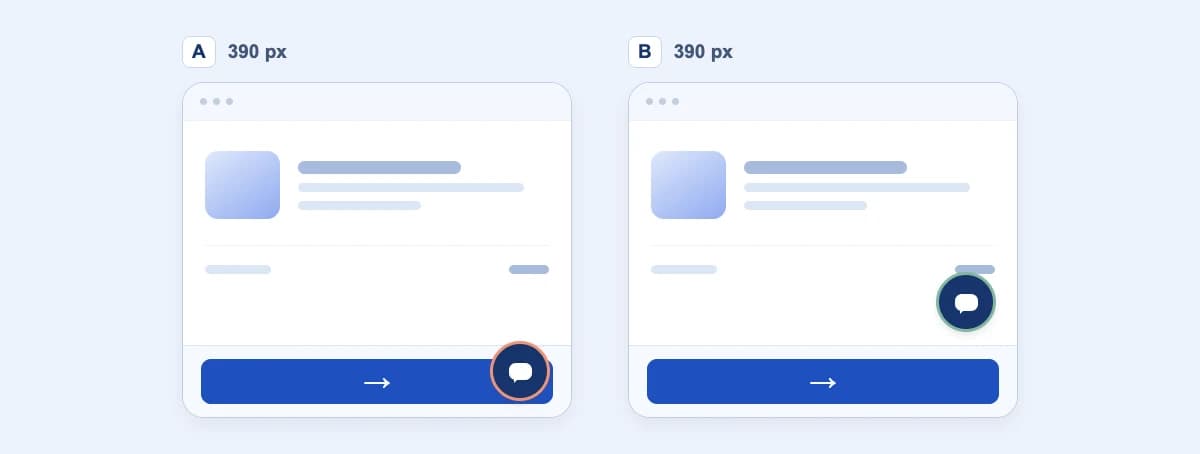
390 px and 1280 px. Use Tab to focus each button and Enter or Space to activate it. Check that there is no horizontal scroll and the desktop layout remains intact. Compare models by retry count and time to first passing output.Open a minimal HTML reproduction
Save the snippet as a local HTML file and screenshot it at 390 px. Give the agent that screenshot and the file. Keep panel B as your own grading reference.
<!doctype html>
<meta charset="utf-8">
<meta name="viewport" content="width=device-width, initial-scale=1">
<style>
  * { box-sizing: border-box; }
  body { margin: 0; font: 16px system-ui; }
  .checkout { position: relative; width: min(100%, 720px); height: 336px; }
  .actions { position: absolute; inset: auto 0 0; padding: 13px 18px; }
  .actions button { width: 100%; height: 45px; }
  .help { position: absolute; right: 24px; bottom: 19px; width: 54px; height: 54px; }
  @media (min-width: 768px) { .help { bottom: 88px; } }
</style>
<div class="checkout">
  <output aria-live="polite"></output>
  <div class="actions">
    <button onclick="this.closest('.checkout').querySelector('output').textContent = this.textContent">Checkout</button>
  </div>
  <button class="help" onclick="this.closest('.checkout').querySelector('output').textContent = this.textContent">Help</button>
</div>
3 Benchmark Tasks to Decide Whether to Switch
| Evaluation Task | Current Baseline | Pass Criteria |
|---|---|---|
| Cross-file repository bug fix | GLM-5.3 | New regression tests and existing CI pass; patch stays strictly within target scope. |
| Screenshot-based layout fix | GLM-5.3 Flash | Overlap resolved on both desktop and mobile; adjacent components remain intact. |
| Long task with mid-run tool failure | GLM-5.3 | Model recovers autonomously after a failed test or tool call; final artifact is verifiable. |
GLM-5.4 Release FAQ
When will the GLM-5.4 standard API be available?
As of November 24, 2026, Zhipu's pay-as-you-go API for GLM-5.4 is pending completion of a security evaluation. Zhipu has yet to announce an opening date. Coding Plan users can access the model through ZCode and other supported tools.
Are the GLM-5.4 model weights available?
Not yet. Zhipu stated that GLM-5.4 weights are planned for release after further security hardening.
How do I use GLM-5.4 in Claude Code?
glm-5.4[1m] using a supported Coding Plan setup. For other compatible tools, use glm-5.4.What is the main difference between GLM-5.4 and GLM-5.3?
GLM-5.4 introduces a Loop Transformer architecture (running 28 shared-weight layers twice) and a 1M token context window. In Zhipu's 200-task internal coding evaluation, GLM-5.4 achieved a 51.1% win rate against GLM-5.3, and eligible weekly-quota users receive roughly 1.5x the token allowance.