Gemini 4 Hydrogen vs Gemini 3.8 Flash: Upgrade Guide
A practical Hydrogen upgrade decision: shared context, thinking defaults, caching changes, fair task evaluation, total cost and rollback.
 EvoLink TeamProduct Team
On this page
There is no controlled EvoLink workload benchmark in this article. The comparison combines documented differences with a reproducible evaluation and rollout method. It is meant to help you make a decision before changing production traffic, rather than declare an overall winner from community demos.
Decide which kind of upgrade you need
A stable classification pipeline and a coding agent can reach different conclusions about the same model. The classifier may have little remaining quality headroom, while an agent's first-pass failure rate may make a more expensive response worthwhile. Treat those as separate routing decisions.
| Current situation | Initial decision | Evidence needed to change it |
|---|---|---|
| 3.8 meets quality, cost and response-time targets | Keep it as the control | A specific improvement that matters to the business |
| Repeated failures on document or code tasks | Trial Hydrogen on those failure classes | Correct accepted results, not a more persuasive explanation |
| Tasks need output beyond the current response cap | Investigate long-output architecture | Supported continuation, cumulative budgets and interruption handling |
| Your client depends on explicit prompt caches | Audit compatibility before testing | A working implicit-cache strategy and correct usage reconciliation |
| Traffic mixes easy and difficult jobs | Evaluate per class | Class-level error, latency and total-spend comparisons |
Gemini 4 Hydrogen vs Gemini 3.8 Flash: migration differences
| Area | 3.8 Flash baseline | Hydrogen change | Migration check |
|---|---|---|---|
| Context | Separate 1M input and 64K output limits | One 1,048,576-token window for input, thinking and output | Leave answer space instead of filling the input ceiling |
| Thinking | low, medium, high; medium default in Google's migration comparison | Adds xhigh; high becomes the upstream default | Set a route-supported value explicitly |
| Long output | Documented output limit of 65,536 | Long decode can exceed one 65,536-token synchronous hop | Persist continuation state and reconcile total usage |
| Caching | Older clients may create and reference explicit caches | Explicit cache creation is unsupported | Remove explicit-cache dependencies; measure implicit hits |
| Sampling controls | Existing code may send sampling fields | Google says custom temperature, top_p and top_k are ignored | Remove assumptions that these tune Hydrogen's behavior |
| Tool declarations | Older prompt wrappers may ask for raw-text JSON “tool calls” | Google warns this can cause MALFORMED_FUNCTION_CALL without declared native tools | Declare function tools or a structured-output schema; follow the chosen gateway’s request contract |
| Tool history | Client-managed state requires protocol-specific handling | Preserve model turns and thought signatures as documented | Test multi-turn history rather than only the first request |
The most easily missed example is the shared context: a request that previously fit near a separate input ceiling can leave insufficient shared space on Hydrogen. Separately, the selected output cap limits thinking and answer tokens together. Lowering that cap does not recover visible-answer capacity when thinking consumes it. Check both shared-window headroom and the configured cap, along with finish reason and usage, before diagnosing a shorter answer as lower intelligence.
Caching deserves its own compatibility test. A repeated prefix is an opportunity for an implicit hit, not a guarantee that the cache warmed, remained valid or transferred between models. Run both warm-prefix and varied-prefix cases, and use the observed cache-read counts. Do not make a migration budget depend on hypothetical hits.
Compare a complete task, not a selected demo
A useful test contains tasks you already run, written acceptance rules and a fixed environment. The three examples below are evaluation designs, not reported model results.
Coding: a patch that survives execution and review
Choose a bug with a regression test, such as retaining a filter while moving between paginated results. Freeze the repository revision, dependencies, allowed files and task instructions. Give both models the same relevant evidence, test access and permission boundaries.
A pass requires the expected behavior and no unacceptable regression or unrelated changes. Record test results, reviewer corrections and the number of turns needed to reach a usable patch. If one model prints an elegant solution quickly but the patch fails, it has not beaten a slower accepted patch. Compare completion time after testing and correction, while keeping time-to-first-token as a separate responsiveness measure.
Include at least one case where evidence is incomplete. A model that asks for the missing contract should not be penalized for refusing to invent it; define that scoring rule before reviewing outputs.
Extraction: correct fields with evidence
Use a product sheet or service agreement with a fixed schema and a labeled reference. Include unit conversion, absent fields and a conflict between two document revisions. Both models should see the same source and receive the same missing-value instructions.
Score field-level accuracy and record-level acceptance separately. One incorrect critical amount can invalidate an otherwise accurate record. A schema check is necessary but cannot validate factual correctness. Mark review-required outputs explicitly, so the test does not confuse safe abstention with an automatically completed record.
Agents: correct tool completion under failure
Create deterministic tool fixtures for a lookup, a timeout and a permission denial. Record valid arguments, completed operations and truthful final responses. A plan to call a tool is not completion, and returning a fictional result after a timeout should fail.
Keep evaluation tools read-only or simulated. During a shadow test, do not perform a second payment, refund or customer notification just because both models propose it. Idempotency, authorization and execution ownership must be enforced by the application independently of model choice.
Make configurations comparable without hiding differences
Run two complementary comparisons. First, evaluate the configuration you would actually deploy on each model. This answers the production question. Then, if supported, hold the selected thinking level and task limits closer together to investigate why behavior changed. Report both configurations; do not label them identical merely because a field has the same name.
A low-setting Hydrogen response and a high-setting 3.8 response can be a valid product-policy comparison, but it is not a controlled claim about model speed at equal reasoning settings. Defaults are particularly dangerous because Google's documented change from medium to high alters the experiment silently.
Freeze the task set before looking at results. Separate easy, typical and failure-prone cases. Keep task weights tied to production frequency or explicitly report an unweighted diagnostic set. Otherwise adding many easy examples can conceal regressions in a rare, expensive workflow.
| Evaluation record | What to store | Why it matters |
|---|---|---|
| Task and truth | task ID, input version, expected outcome, critical-error rules | Keeps labels and scope stable |
| Request contract | requested model, returned identity when available, channel, thinking, budget, tools | Exposes defaults and routing differences |
| Outcome | first-pass acceptance, final acceptance, failure category, review state | Prevents style from replacing correctness |
| Time | first token, end of generation, accepted-result time | Separates responsiveness from task completion |
| Usage | uncached input, cache reads, visible output, thinking, search and retries | Supports a complete bill reconciliation |
| Rollout context | app version, tool fixture, concurrency and timeout | Makes changes reproducible |
Repeat variable tasks where necessary and report variability. A small sample can find an obvious regression, but it cannot prove a stable tail latency or a rare-error rate. Decide the sample size and production window based on the failure you need to detect. Record missing measurements as missing rather than zero.
Calculate the break-even point for accepted work
For a dated upstream reference, Google Standard rates checked November 12 put Hydrogen at $1.50 input and $7.50 output per million tokens, versus 3.8 Flash at $0.75 and $3.75 through December 31, 2026. Those two current token rates are twice as high—not proof of twice the task cost. Google lists 3.8 rates of $1.50 and $7.50 starting January 1, 2027. Recheck the effective period, caching and tool terms; these are direct-provider reference rates, not EvoLink account quotes.
Use one consistent definition:
API cost per accepted task = all API and tool spend for the batch / accepted tasksThe numerator includes failed attempts, retries and fallback calls. Count each original task ID at most once in the denominator. Keep completed tasks separate from safe-but-unfinished clarification or review cases, unless the prewritten task contract defines that disposition itself as the completed outcome. If the denominator is zero, the result is undefined—not a bargain. Report the share of tasks that reached an accepted result, since a policy that rejects hard requests can lower costs without delivering equivalent work. If human correction matters, report a separate combined cost using the same labor unit price, such as dollars per reviewer minute, but each route’s own observed review frequency and time.
| Scenario for 1,000 incoming tasks | Total API/tool spend | Accepted tasks | Cost per accepted task |
|---|---|---|---|
| Working baseline | $8 | 800 | $0.0100 |
| Challenger A | $12 | 960 | $0.0125 |
| Challenger B | $9 | 960 | $0.009375 |
Challenger A produces more accepted tasks but is not cheaper per accepted task. It may still be worth adopting if the extra coverage is valuable; that is a business choice, not a cost-saving claim. Challenger B improves both metrics under the stated assumptions. Neither row predicts actual model behavior.
c_H / a_H < c_F / a_F, where c is average API/tool spend per incoming task and a is the fraction accepted under the same rubric. Use actual complete-loop spend. Do not put a single-response price in c if the policy includes repeated attempts.Reconcile token categories too. When reported prompt usage includes cache hits, subtract them before entering uncached input into the calculator. When reasoning is already included in completion_tokens, do not add it twice. Native and compatible usage fields need separate mappings to the same accounting categories.
Move through replay, shadow and a reversible canary
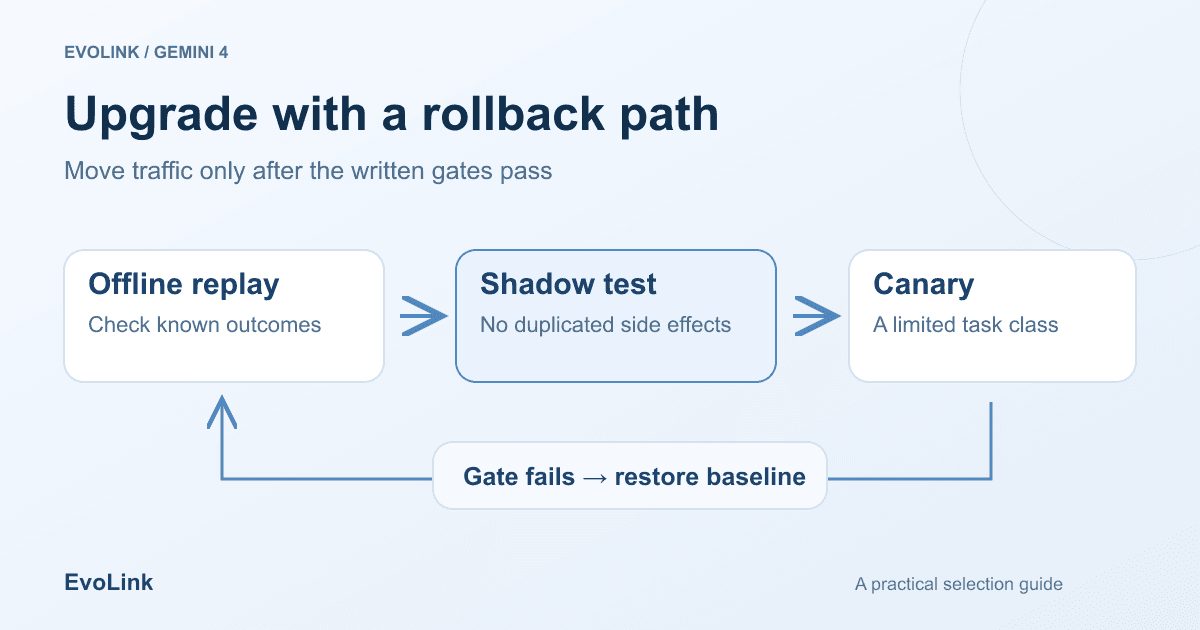
EvoLink's unified API reduces the integration work needed to keep model choices available. The application still owns evaluation, traffic allocation and fallback rules. This guide does not imply an automatic migration or a built-in policy that always chooses the least expensive successful model.
What would justify staying on 3.8?
Keep 3.8 when it meets the acceptance bar and a challenger adds cost or risk without a material benefit. That is especially reasonable for stable workloads with little remaining accuracy headroom, latency budgets sensitive to reasoning changes, or clients whose cache and state handling need work before migration.
FAQ
Is Hydrogen better than Gemini 3.8 Flash?
Google recommends the upgrade, but this article does not establish a universal winner. Evaluate accepted outcomes, critical failures, completion time and complete-loop cost on the task you run.
Must I migrate immediately after the release?
No migration deadline is established here. Keep a working baseline while you validate the challenger and independently check any provider deprecation notices.
Is changing the model ID enough?
It starts the selection, but does not resolve shared-context budgeting, thinking defaults, explicit-cache dependencies, tool state or long-output handling. Verify those against the chosen protocol.
Can I compare using each model's default thinking?
Yes, if you are comparing intended deployment policies and report the difference. It is not an equal-setting benchmark. Set explicit levels for an additional controlled comparison where supported.
Can I reuse an explicit cache created for 3.8?
Do not depend on that path: Hydrogen's upstream migration guidance removes explicit caching. Validate your chosen gateway's implicit-cache behavior and reconcile actual cache usage.
Does a faster stream mean a faster completed task?
Not necessarily. Testing, tool execution, retries and review can dominate the wait. Report first-token time separately from time to an accepted result.
How do I avoid double-counting thinking costs?
Map usage to billable categories for the protocol. Reasoning detailed inside completion_tokens is already part of that total. Add separately reported native thinking only when it is excluded from the visible-output count.
What should trigger a rollback?
Predefined violations of critical-error, quality, accepted-task-cost or completion-time limits. Restore the earlier model and its compatible configuration, then investigate with task-level logs.
Sources and verification notes
- Google Hydrogen migration guidance: upstream defaults, cache and context changes.
- Google Hydrogen specifications: new model limits and supported capabilities.
- Google 3.8 Flash specifications: predecessor baseline.
- Google Gemini API pricing: channel-specific commercial reference.
- EvoLink Gemini native API reference: gateway request contract.
Checked November 12, 2026. The task designs, thresholds and dollar example are analytical guidance, not controlled model test results. Use your current EvoLink account rates and the selected route’s supported controls during rollout.