
Kimi K3.1 Pro vs K3: Which Workloads Are Worth Upgrading?

What changes from K3 to K3.1 Pro?
Moonshot describes K3.1 Pro as a post-trained version of K3 with more post-training compute. Long context and visual understanding remain part of the family; they are not new capacity unlocked by this upgrade. The decision is whether the changed behavior improves your deliverable.
| Dimension | Kimi K3 | Kimi K3.1 Pro | Decision implication |
|---|---|---|---|
| Position | Previous-generation baseline | Further post-trained model | Keep your existing K3 results as a baseline |
| Context | 1,048,576 tokens | 1,048,576 tokens | A larger headline context is not the upgrade reason |
| Target work | Coding and long tasks | Moonshot emphasizes coding, 3D and research gains | Test a weakness in your actual workload |
| Serving choice | Existing K3 route | Pro and Pro Highspeed | Select the variant explicitly |
| Gateway price | Current K3 account rates | Current K3.1 account rates | Compare the selected account, not two unrelated rate cards |
What independent launch evidence establishes
Artificial Analysis published the following launch snapshot on October 23, 2026. The baseline is Kimi K3 at max effort; these are its evaluations, not EvoLink measurements.
| Measurement | K3 | K3.1 Pro | Reading |
|---|---|---|---|
| Intelligence Index | 44 | 55 | Eleven points in this composite evaluation |
| Output per Index task | About 48,000 tokens | About 55,000 tokens | More billed generation can offset rate reductions |
| Cost per Index task | Roughly similar to Pro | About $1.98 | A snapshot of this evaluation, not your budget |
A lower token price is not a task-cost result
Moonshot's international reference rates checked October 24 list ordinary input/output at $3/$15 per million tokens for K3 and $2/$10 for standard Pro. These are direct-provider list prices, not a current EvoLink account quote. Cache writes, cache reads, tools, taxes and retries are separate considerations.
| Case | Ordinary input | Billed output | Reference cost |
|---|---|---|---|
| K3 baseline | 100,000 | 10,000 | $0.45 |
| Pro, same token counts | 100,000 | 10,000 | $0.30 |
| Pro, more generation | 100,000 | 25,000 | $0.45 |
The second case saves money only because token counts are held constant. The third reaches the baseline bill before considering retries or tools. In production, measure the cost of obtaining an accepted result:
accepted_task_cost =
  (initial_call_costs + retry_costs + fallback_costs + tool_fees + review_cost)
/ accepted_deliverablesMatch the upgrade to the workload
| Workload | Try Pro when | Keep the existing route when |
|---|---|---|
| Repository repair | K3 stalls, needs repeated corrections or misses tests | The current patch quality and budget targets already hold |
| Long-document work | Cross-document checking or output completeness is weak | Extraction and retrieval are the actual bottleneck |
| Interactive applications | Better completion quality matters and Pro meets the response target | Waiting time remains unacceptable; measure Highspeed separately |
| Batch or repeat work | Accepted-result cost improves on the same sample | Extra reasoning or review removes the apparent saving |
Highspeed is a separate serving decision. Moonshot's approximately 2–3× output-speed claim does not make a build, tool loop or agent run finish 2–3× faster. Start by establishing Pro's quality and bill, then compare Highspeed if generation time dominates your latency budget.
Use a record that makes the replacement decision reviewable
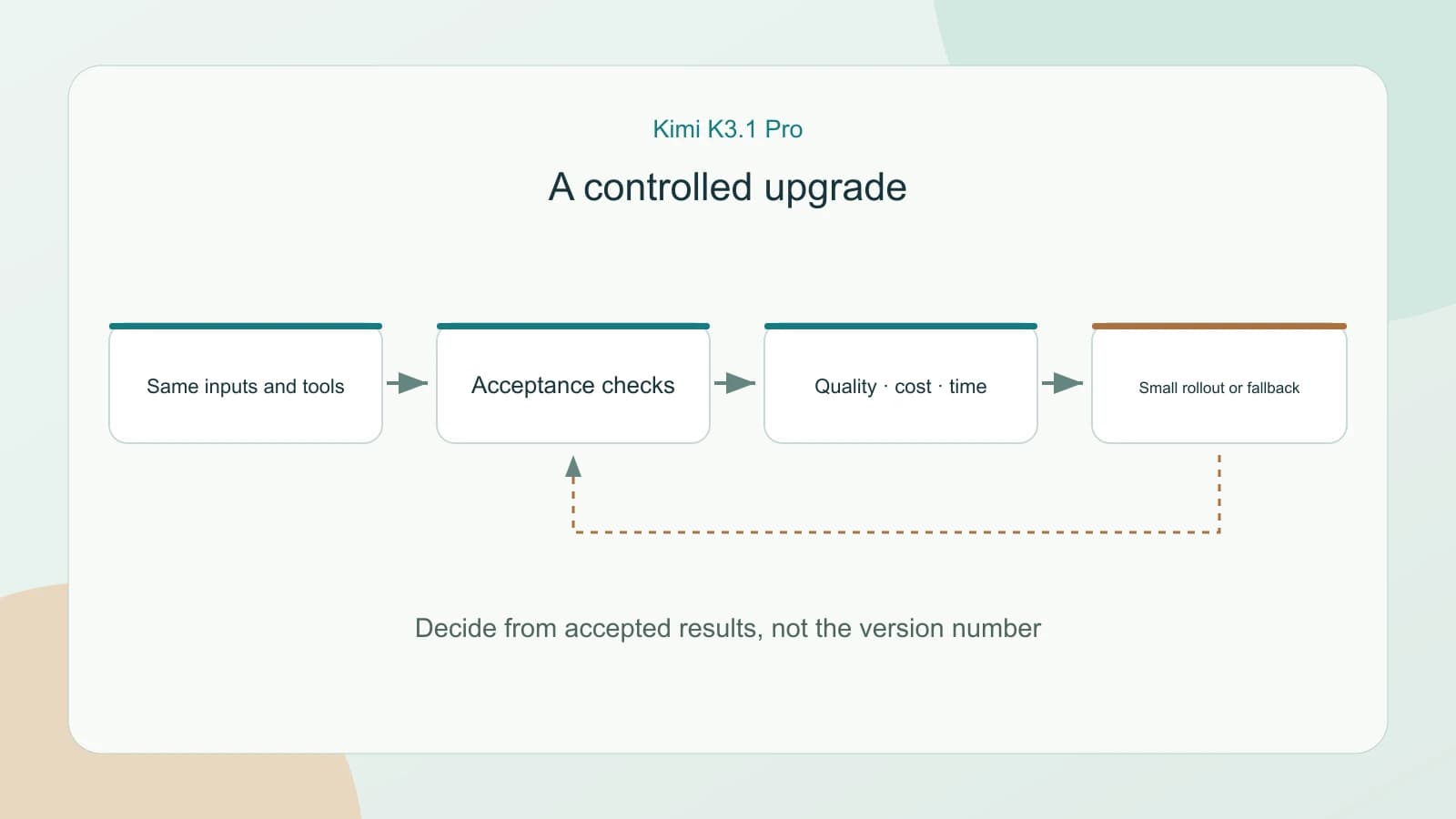
Freeze the repository commit or document set, task prompt, tool environment and acceptance tests. Run each model against those inputs separately. Preserve complete assistant/tool state within a run, but avoid carrying an old conversation into a changed model or reasoning configuration and calling it a controlled comparison.
| Record | What to capture |
|---|---|
| Configuration | Exact model, effort, output budget and route |
| Usage | Ordinary input, cache reads, each write TTL, billed output and tool calls |
| Quality | Acceptance tests, citation accuracy or artifact checks; remaining defects |
| Operations | First response, full elapsed time, retries and failures |
| Cost | Actual account charges, fallbacks and measured review effort |
Count cache reads and each write category according to returned usage; do not count a write again as ordinary input. Keep the key, protocol and image-upload contract tied to the selected service. A compatible request shape does not guarantee equivalent behavior.
Roll out the workload that passed
First compare without moving user traffic. Define a quality floor, spending limit and latency target before inspecting results. Move a small workload segment only after the replacement meets those conditions, and keep the previous configuration available for rollback. Expand after observing failures and billing on real traffic, rather than after a single attractive answer.
For example, if a repository task passes tests but requires more manual repair, record that review cost. If long-document answers fail because extraction dropped tables, fix extraction before attributing the issue to the model. These counterexamples prevent an upgrade from hiding the actual bottleneck.
FAQ
Is K3.1 Pro always better than K3?
No. Launch evidence supports evaluation, but the replacement must satisfy your workload's quality, cost and latency conditions.
Is the context window bigger?
No. Both listed models have a 1,048,576-token window. Input, reasoning and output share the available budget.
Does a lower list price guarantee a lower bill?
No. Output volume, cache accounting, tools, retries and review can change the cost of an accepted result. The planning example holds assumptions explicit.
Should I start with Highspeed?
Establish Pro's baseline first unless your response-time requirement makes it unsuitable. Measure Highspeed with the same task and current rates.
Which reasoning effort should I choose?
Use the documented settings and compare them on your acceptance tests. Do not infer low/high/max quality from a score reported only for another configuration.
Can I reuse my existing conversation unchanged?
Preserve required tool state within a run, but start a separate controlled run when changing model or reasoning settings. Verify service-specific conversation requirements.
When should I keep K3?
Keep a verified route when it already meets targets and the replacement has not demonstrated better accepted-result economics or quality.
Does this comparison include an EvoLink head-to-head test?
No. It combines attributed launch evidence with a constructed cost example and an evaluation procedure. Empty test records are not measured results.