Gemini 4 Hydrogen Released: Features and Adoption Guide
Gemini 4 Hydrogen is live on EvoLink. See how multimodal inputs, thinking controls and shared context fit coding, document and tool workflows.
 EvoLink TeamProduct Team
On this page
gemini-4-hydrogen as generally available. For a team selecting models through EvoLink, the useful next question is which application task deserves a controlled evaluation—not whether a new name alone justifies replacing an existing route.What the release actually confirms
The release changes the evidence baseline. Earlier articles discussed a Flash-tier codename and blind-test sightings; Google's dated developer documentation now establishes a public model. Use the documented ID rather than an inferred Arena alias. “Gemini 4 Flash” may explain how someone encountered the story, but it should not become an invented request identifier or a claim about the model's architecture.
| Question | Confirmed upstream fact | Application consequence |
|---|---|---|
| What can it read? | Google's model page lists text, images, audio, video and PDF | Choose an output contract and evaluate each input type separately |
| What does it return? | Text, with structured-output and function-calling support | Validate data; your application authorizes and executes its own function tools |
| What is the context budget? | 1,048,576 tokens shared by input, thinking and output | Reserve room for the answer before filling the context |
| How long can it respond? | A synchronous hop allows up to 65,536 thinking and answer tokens combined; long decode extends the workflow | Treat long generation as a resumable workflow |
| How is thinking controlled? | Upstream documents low, medium, high and xhigh; high is the default | Set a supported level explicitly and measure its full cost |
| How is caching handled? | Implicit caching; explicit cache creation is not supported | Recheck older explicit-cache integrations |
xhigh does not by itself establish gateway parameter support. Apply the same protocol check to native-only file formats and long-output handling.Gemini 4 Hydrogen features that change a workflow
A capability matters when it changes a task you can verify. “Supports images” is not a document-processing policy, and “calls functions” is not an agent completion metric. Start with one bounded task, a clear output contract and a way to reject plausible but incorrect responses.
Document understanding: turn evidence into a checked record
Consider a vendor onboarding application reading a multipage product specification. Its job might be to extract supported operating temperatures, certifications and the page supporting each value. Ask for source references and an explicit missing-value representation; do not invite the model to fill an incomplete table from general knowledge.
The acceptance contract needs three layers. First, the response must match the schema. Second, each value must agree with the supplied document, including units and qualifiers. Third, the application must handle absence or conflict: send an unreadable table to review, distinguish “not stated” from “not supported,” and reject a citation that points to the wrong page. A syntactically valid record can fail the other two layers.
This is a useful first evaluation because field errors are inspectable. Include scanned pages, conflicting revisions and missing fields rather than testing only clean examples. Track accepted records, manual-review rate and all attempts' billed usage. A larger context window may let you include more evidence, but it does not ensure the model resolves conflicting versions correctly.
Coding: score a working change rather than an attractive demo
For a coding assistant, choose a small repository task with observable behavior: fix a pagination bug while preserving filtering, or add idempotency handling around an existing endpoint. Record the starting revision, test command, allowed files and constraints. Run the generated change in a sandbox with the same dependency versions used by the baseline.
A task passes when the required behavior works, relevant tests pass and the change stays within scope. A beautiful interface that loses keyboard support or a plausible patch that removes a validation check should fail. Record time to a reviewable result, including installation, test failures and corrective turns; response-generation time alone leaves out much of the user's wait.
Do not interpret a code-generated animation as native video generation. Hydrogen's documented output is text. Code can create an interactive or visual artifact, but it still needs execution and inspection.
Tool workflows: require a completed, authorized action
A support agent might read an order, look up the shipping status and propose a customer response. Evaluate whether it chooses an allowed tool, supplies valid identifiers, interprets the returned state and stops when information is missing. For your own function tools, the application—not the model—checks permissions and performs side effects. Provider-managed tools such as Google Search have their own execution and billing contract.
Preserve the protocol's conversation and thought-signature requirements. Include a tool timeout and an authorization denial in the test set. A model should not invent a shipment after a failed lookup or retry a write blindly. Track completed tasks and safe escalations separately: a correct refusal can be better than a confident false completion.
| Workflow | Evidence to preserve | Failure that should stop automatic acceptance |
|---|---|---|
| Product-document extraction | Source page, units, schema and reference values | Unsupported value, conflicting version or unreadable evidence |
| Repository change | Starting revision, patch, test output and review criteria | Regressions, scope expansion or failed execution |
| Order-status agent | Tool arguments, authorization outcome and tool response | Unauthorized action, fabricated status or incomplete tool loop |
Shared context changes how you budget long tasks
As an illustrative capacity calculation, 800,000 input tokens leave at most 248,576 tokens inside a 1,048,576-token window for thinking and output together. System instructions, tool definitions and other counted material reduce the space if they were omitted from that input estimate. This is arithmetic, not an observed model response or a recommended prompt size.
Before enabling a long-output feature, answer operational questions: where is partial output stored, what happens after a disconnect, how do you avoid appending the same segment twice, and when is a partial document considered unusable? Stop reasons, cumulative usage and a task-level deadline belong in the implementation. A million-token ceiling does not remove these requirements.
Thinking is a workload control, not a quality guarantee
xhigh gives another evaluation setting. It does not establish a new default for every application, nor prove a gateway exposes the option. Google's guidance recommends reserving the higher setting for difficult tasks and warns about increased token use and latency. Check supported controls on your chosen route first.For a document extraction workflow, compare field accuracy and unsupported-value rate. For a coding workflow, compare tests and corrective turns. For tools, compare completed operations and safe handling of failures. Change the thinking setting while keeping those acceptance checks fixed. Keep a setting because it helps the task, rather than because its label sounds more capable.
Set explicit configuration during comparisons. Otherwise a model's different default can look like a generation-level change. An output cap also includes thinking: a request can consume its budget before producing enough visible answer text. Record both the configured budget and the returned usage so you can distinguish a truncated answer from a knowledge failure.
Availability depends on which channel you mean
| Channel, checked November 12 | What the available evidence supports | What to verify before depending on it |
|---|---|---|
| Google Gemini API | Official GA release and documented model ID | Project eligibility, quotas, terms and supported API surface |
| Google AI Studio | Official migration guide lists access | Your account's actual access and usage conditions |
| Gemini consumer app | User reports are account-specific observations | Current account, region and feature availability |
| Antigravity desktop product | A visible model picker is a separate product signal | Actual returned model and account entitlement |
| Google's managed Antigravity agent | Official release notes name Hydrogen as its default | Managed-agent contract; this is not proof about every Antigravity product |
| EvoLink | Hydrogen is available through the unified API | Current account rates, the selected protocol and supported controls |
The table prevents two common mistakes. A consumer subscription is not an API billing agreement. And an upstream feature release does not prove a gateway has implemented every new parameter. EvoLink's value is a consistent integration point for comparing and selecting supported routes; it does not erase channel-specific controls or limits.
Estimate a completed task, not just its first response
For application planning, add uncached input, cache reads, billable output and tool charges across every attempt. Keep human correction cost separate if you measure it. Divide the relevant total by accepted tasks, and report the failure rate alongside the cost so that rejecting difficult tasks cannot make a route look artificially efficient.
Run a bounded first evaluation
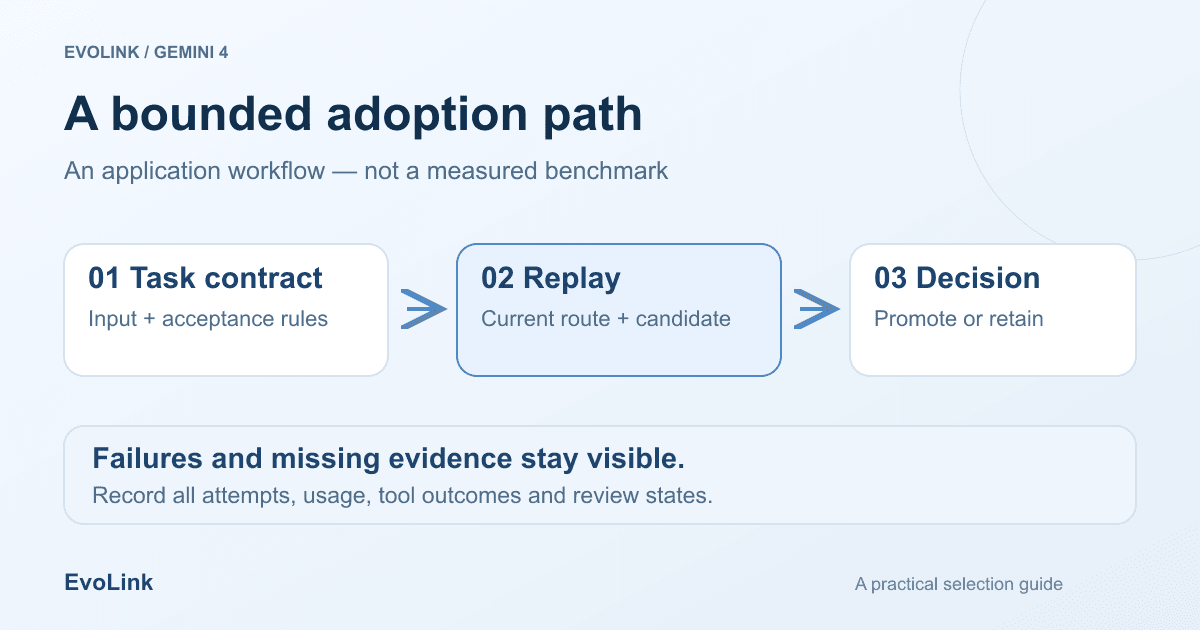
Begin with one workload whose failures you can explain. A useful evaluation packet contains the inputs, acceptance rules, current baseline outputs, failure categories, tool fixtures and a budget. Keep sensitive source material within your approved data-handling policy; a model launch is not a reason to change that policy.
Replay the workload against the current model and the Hydrogen candidate. Include ordinary cases and known failures, record per-attempt configuration and score against the written criteria. Inspect the disagreements: a higher aggregate score can conceal a critical regression in a small but valuable task class.
Promote only the task class that clears your requirements. A small production slice should have a configured fallback, an error budget and an owner who can disable the candidate. Leave unrelated traffic on its working route. These are application rollout recommendations, not a claim that EvoLink automatically performs evaluation or fallback for you.
FAQ
When was Gemini 4 Hydrogen released?
Google's Gemini API release notes record general availability on November 12, 2026. Access and commercial terms still depend on the product and account you use.
Is Hydrogen the same as the rumored Gemini 4 Flash?
Flash is a useful historical search label, but use the public name Gemini 4 Hydrogen and its documented identifier. A community alias does not establish an architecture, another callable model ID or the identity of an earlier blind test.
Is it automatically available in every Gemini product?
No single release note proves that. Google API, AI Studio, consumer apps, managed agents, IDE products and gateways need separate access checks.
Does it generate images, audio or video?
Google lists multimodal inputs and text output. Understanding media or generating code that renders an animation is different from native image, audio or video generation.
Should I always choose xhigh thinking?
Use it only on a route that supports it, and only when measured task outcomes justify the added time and token use. The current EvoLink integration's documented settings must be checked independently of the upstream announcement.
Can one ordinary request return a million answer tokens?
Do not treat the long-decode ceiling as a single-response guarantee. Input and thinking share the window, and long output requires the relevant API's supported continuation or background mechanism.
Should I replace 3.8 Flash or Argon immediately?
Keep a working route until a representative evaluation establishes a reason to change. The two comparison guides cover different choices: upgrading a baseline and distributing tasks across models.
Where should EvoLink users begin?
Open the live Hydrogen model page, check your current account rates, choose an input and acceptance contract, and run a bounded first task with the supported protocol.
Sources and evidence boundaries
- Google Gemini API release notes: release date and upstream lifecycle.
- Google Hydrogen model specifications: modalities, context and capability baseline.
- Google Hydrogen changes and migration guidance: thinking and long-decode design.
- Google Standard pricing: upstream commercial reference, checked November 12, 2026.
- EvoLink native API documentation: gateway protocol authority.
The workflow examples are proposed acceptance contracts. They are not published Hydrogen benchmark results, account-level availability tests or measured application savings.