Gemini 4 Hydrogen vs Argon: Which Tasks Fit Each?
A production routing guide to Gemini 4 Hydrogen and Gemini 4 Argon: workload decisions, complete-loop costs, escalation signals and fallback limits.
 EvoLink TeamProduct Team
On this page
No controlled Hydrogen-versus-Argon workload results are presented here. The capability baseline comes from provider documentation; the policy, examples and formulas are application design guidance.
In Google’s model-selection guidance, Hydrogen is a candidate for everyday coding, multimodal document work and parallel execution; Argon is positioned for advanced long-horizon tasks. That is provider positioning, not a measured division of your traffic. For example, a repository service can evaluate routine test-backed edits on one route and cross-module failure analysis on another, using the same revision and acceptance checks. Promote either assignment only if the results support it.
Gemini 4 Hydrogen vs Argon: shared capabilities and limits
| Selection variable | Hydrogen upstream baseline | Argon upstream baseline | What to check on EvoLink |
|---|---|---|---|
| Shared context | 1,048,576 tokens across input, thinking and output | Same shared-window design | Protocol limits and the input space left for the answer |
| Long output | Long decode beyond a synchronous hop | Long decode supported | Native continuation behavior; do not infer compatible-protocol support |
| Thinking | low, medium, high, xhigh; high default | low, medium, high; medium default in Google's comparison | Supported values and an explicit chosen setting |
| Non-streaming hop | Google documents up to 65,536 | Google compares a 32,768 REST hop limit | Your actual gateway contract and SDK behavior |
| Tool and structured-output work | Supported capabilities | Supported capabilities | Schemas, thought signatures, error handling and tool execution |
| Pricing | Separate model and commercial schedule | Separate model and commercial schedule | Current account rate, including cached input and tools |
xhigh as enabled until the route documentation confirms it. Similarly, a difference in Google’s REST limit is not evidence that your gateway silently implements the same difference.Do not turn the models into a speculative architecture story. “Distilled Argon” is not established by a price ladder, an element name or a similar response. What matters operationally is the supported interface and the quality of accepted work under your configuration.
Choose a route by the task's failure cost
Start with the output contract and what an error would do. A model can be a good first candidate for a task without being the safest route for a more consequential variant of that task. Record the task classes separately so an average score does not conceal a critical failure.
| Workload | Initial evaluation policy | Acceptance test | When the initial policy is insufficient |
|---|---|---|---|
| Fixed-field document extraction | Test Hydrogen against the current route | Required fields, exact values, units and source evidence | Critical fields fail or ambiguity cannot be resolved |
| Repository maintenance | Compare both on reproducible tasks | Tests pass, change stays in scope, review burden acceptable | Difficult failures remain and Argon demonstrably resolves them |
| Multi-step tool agent | Start with the route already meeting the completion bar; trial the other | Authorized tools complete and the final answer reflects their results | Valid requests repeatedly fail the task despite reliable tools |
| Long report or generated specification | Check context and continuation before choosing by model | Complete sections, valid references, resumable output | The client cannot resume correctly or evidence is missing |
| High-impact judgment without automatic ground truth | Require a documented review process | Human-reviewed rubric and critical-error checks | Neither model can supply the necessary evidence or authority |
For extraction, the question is not whether Argon sounds more careful. It is whether it corrects a specific failure against a reference. For coding, ask whether it fixes the failing behavior without creating another regression. For an agent, distinguish a model error from a failed tool service: changing the model cannot restore an unavailable database or grant a missing permission.
A role such as “worker” or “verifier” is a proposed application assignment, not a capability tier guaranteed by the model name. Evaluate the verifier too. Two models can agree on an unsupported answer; agreement is not an independent source of truth.
Decide between direct routing and escalation
There are three useful starting policies. Compare all of them on the same incoming task population, with the same definition of accepted work.
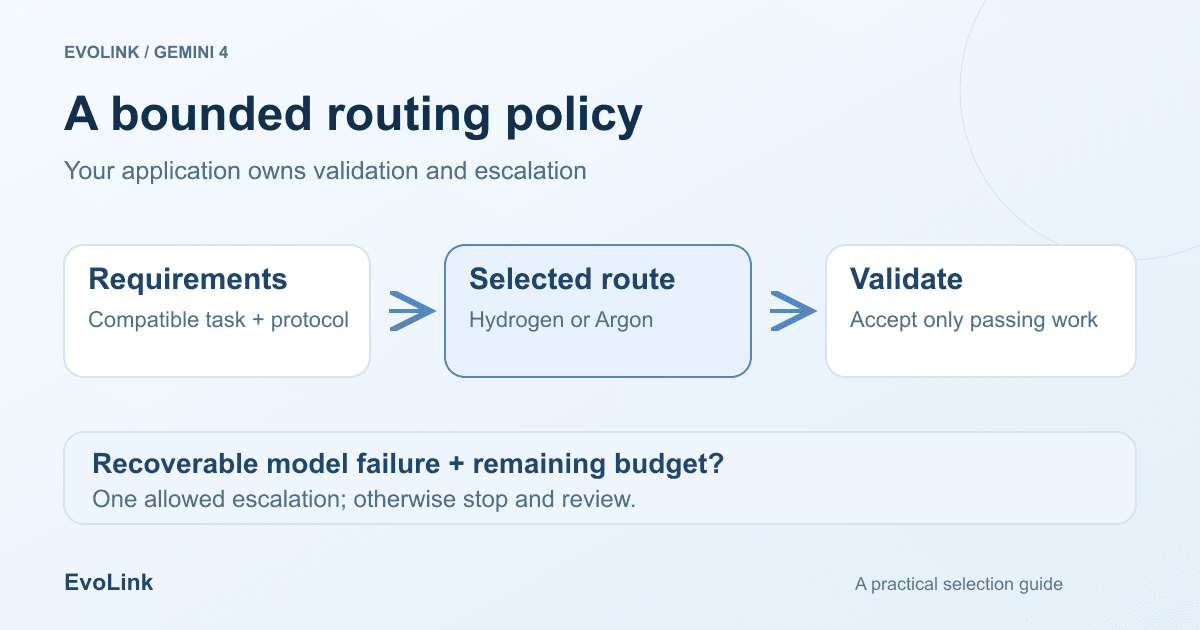
A practical decision tree works in this order:
- Check hard requirements. Does the selected protocol accept the input, expose the needed tool and support the required output workflow? Reject an incompatible route before comparing model quality.
- Use evaluated task-class results. Select the direct route that meets quality, latency and cost requirements for this class. If there is no such evidence, run a bounded evaluation rather than infer a winner.
- Validate the response. Apply schema, execution, evidence and authorization checks. Accept only what passes the task's requirements.
- Classify a failure. Missing evidence, unavailable tools, denied permission, malformed data and a genuine model reasoning failure need different handling.
- Escalate only a recoverable model failure. Carry relevant original evidence and validation feedback, check remaining budget and time, then make the permitted second attempt.
- Stop at the policy limit. If the second attempt fails, return an explicit incomplete/review state. Do not cycle between models until one produces a convincing answer.
This is application-side orchestration advice. It does not describe a built-in EvoLink feature that automatically evaluates responses or routes every failure to a better model.
Price the entire route, including unsuccessful work
For an escalation policy, let:
c_Hbe the average total Hydrogen-stage API/tool cost per incoming task, including retries allowed within that stage;rbe the fraction of all incoming tasks that actually reach Argon;c_Abe the average complete Argon-stage API/tool cost for an escalated task;abe the fraction of original tasks that ultimately satisfy the shared acceptance rubric.
Then:
average API/tool cost per incoming task = c_H + r × c_AAPI/tool cost per accepted task = (c_H + r × c_A) / aThe second expression is undefined when a is zero. If you include reviewer time, add its expected cost explicitly instead of presenting API-only spend as the whole business cost. The population and acceptance rules must remain the same across policies.
Include billable model-based validation in the stage that invokes it. If a separate model or service judges the response outside those stages, add its expected cost to the numerator before dividing by acceptance. Report local test execution or other infrastructure costs separately when they are outside your API/tool-spend definition.
| Policy | Total API/tool spend | Accepted original tasks | API/tool cost per accepted task |
|---|---|---|---|
| Hydrogen only | $6 | 800 | $0.0075 |
| Argon only | $12 | 960 | $0.0125 |
| Hydrogen, then Argon for 200 tasks at $0.012 each | $8.40 | 950 | About $0.00884 |
For the third row, $6 + 200 × $0.012 = $8.40. If Hydrogen had accepted 800 originals, a total of 950 implies 150 of the 200 escalations produced an additional accepted task. These are illustrative assumptions, not observed acceptance rates, model prices or a promise of savings. The policy outcomes are assumed separately, not a deterministic paired test: escalation can use validation feedback and different request context. Measure its success and c_A on the actual escalated subset rather than deriving them from the direct-Argon average. This example assumes local validation without an extra model API fee; add any billable validator cost as described above.
The policy can become unattractive quickly. If too many tasks escalate, the first stage adds cost before the route you would have used anyway. If the validator misses wrong answers, the reported acceptance rate is misleading. If it rejects correct answers, unnecessary escalation consumes both time and money. Validate the validator against human-labeled or executable reference cases.
Latency also changes with the policy. An escalated task experiences the first stage, validation and second stage in sequence. Do not average two independently measured p95 values and call that the route's p95. Measure end-to-end completion time on the actual policy, and report escalated tasks separately so a fast majority does not hide a slow failure tail.
Define escalation signals that can be audited
A useful signal is tied to a failed task requirement. A vague self-assessment such as “I am not confident” may be one feature to inspect, but should not become an unlimited spending authorization.
| Signal | First action | When another model is reasonable | Stop condition |
|---|---|---|---|
| Required schema or type check fails | Check request/schema correctness | The valid request remains unsatisfied and the alternative passed this failure class in evaluation | One allowed escalation or the task budget |
| Executable test fails | Preserve the test output and relevant original context | A model-level correction is plausible and safe to attempt | Tests still fail or scope expands |
| Citation is unsupported | Check whether the source actually contains the answer | Another interpretation is useful only when evidence exists | Missing evidence: ask for it or review |
| Tool times out | Apply the tool service's retry policy | A model switch does not fix service availability | Timeout/deadline reached |
| Authorization denied | Respect the denial | Never use another model to bypass permission | Stop the unauthorized operation |
| Context does not fit | Reduce/retrieve relevant evidence or change the workflow | Only if the other route genuinely has a compatible capacity | Neither route fits safely |
For example, a generated migration script that fails a reproducible test can carry that test failure into an Argon attempt. A tool response saying “permission denied” should not. A PDF with an unreadable signature cannot become reliable evidence because a second model guessed the same name.
Avoid repeated writes during escalation. If a first attempt may already have executed an operation, reconcile its status before trying again. Preserve idempotency identifiers and keep the execution layer responsible for side effects. Model selection does not remove the application's transaction boundary.
Preserve state without assuming model portability
previous_interaction_id feature, native continuation token or state object is accepted by an unrelated gateway endpoint.For an application-managed escalation, construct the next request from approved original evidence and an explicit description of what failed. Do not present a failed model's unsupported conclusions as ground truth. If transferring state is not documented, start a supported fresh request and price the repeated input; hiding that input cost would distort the route comparison.
Keep configurations named and versioned. A rollback target should include model, supported thinking level, prompt version, schema and tool policy. This avoids reverting the model while leaving a setting the fallback cannot accept.
Roll out a policy before making it the default
Evaluate both direct routes before the cascade. Otherwise you cannot tell whether the extra routing layer improves anything. Freeze a labeled set containing ordinary, difficult and known-failure tasks, then test direct Hydrogen, direct Argon and the proposed escalation path. Record all attempts under the original task ID.
Inspect model and validator disagreements. Review critical errors even if the average cost improves. The acceptance gate must also remain independent enough to detect confident but incorrect outputs; a verifier that simply repeats the first model's explanation is not a strong gate.
Next, run an approved shadow policy with side effects disabled. Confirm the live input distribution, state handling, actual escalation frequency and complete usage. Then use a limited canary with written limits for critical failures, accepted-task cost, completion time and tool actions. Keep an immediate direct-model fallback and an operator who can disable the policy.
Do not force every request into the cascade. Known difficult classes may be cheaper and faster on a direct route. Straightforward classes that already pass may need no second model. For classes without reliable acceptance tests, manual review or a clearly incomplete outcome may be safer than another automatic attempt.
FAQ
Should every task start with Hydrogen because its token rates are lower?
No. Test complete-loop cost and outcomes. A task that nearly always escalates can be better served directly by its proven route.
Is Hydrogen a distilled version of Argon?
This article has no primary evidence establishing that architecture. Use the documented model identity and supported behavior rather than infer training design from positioning.
Does Argon always produce a better answer?
No such universal result is established here. Compare both against a task-specific reference, including difficult cases and critical errors.
Is long output a reason to choose Argon over Hydrogen?
Both upstream models document long decode. Check shared context, hop limits and the selected protocol's continuation behavior; do not treat a shared feature as a unique Argon advantage.
When should I escalate to Argon?
When a detectable, recoverable model failure remains, your evaluation shows the alternative helps that failure class, and the task still has budget and time. Missing permission or missing evidence requires a different response.
Can the second model verify the first automatically?
It can participate in a proposed review workflow, but agreement does not prove correctness. Evaluate the verifier and use executable checks, source evidence or human review where required.
Can I reuse conversation, cache and continuation state across models?
Only where the chosen protocol documents it. Preserve required history correctly, avoid moving model-specific tokens blindly, and account for repeated input when starting a fresh request.
When should the workflow stop retrying?
At the written attempt, time or spending limit, or when the failure cannot be fixed by another model call. Return a clear review/incomplete state instead of an endless model-switching loop.
Sources and evidence boundaries
- Google Hydrogen model specifications.
- Google Argon model specifications.
- Google Hydrogen cross-model migration guidance.
- Google Gemini API pricing.
- EvoLink Gemini native API reference.
Checked November 12, 2026. Provider specifications are channel-specific. Workload assignments, routing rules and the 1,000-task example are proposed designs, not a published model benchmark or a description of automatic EvoLink routing.