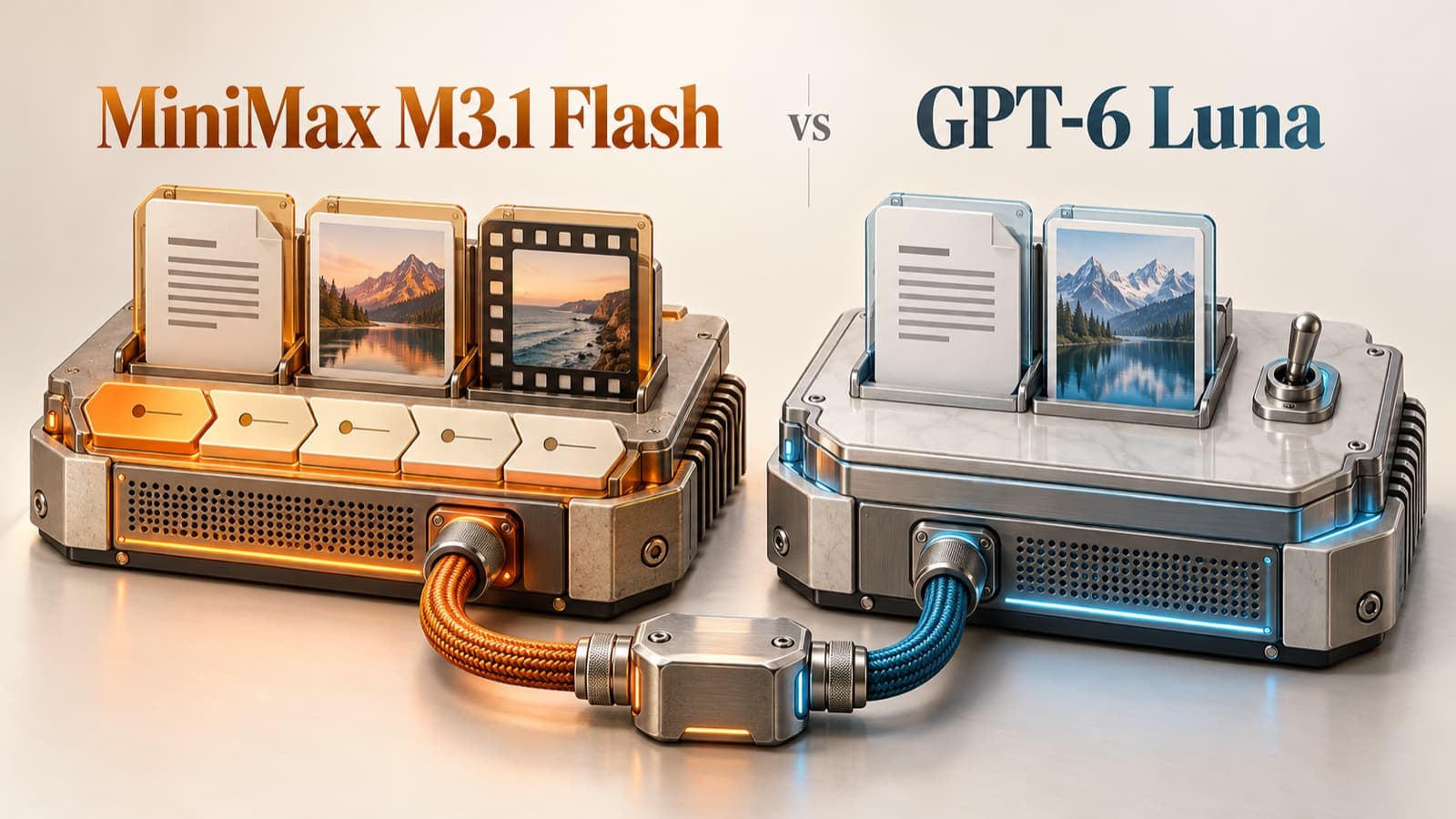
MiniMax M3.1 Flash vs GPT-6 Luna: Inputs and Tools

MiniMax M3.1 Flash vs GPT-6 Luna: input and tool contracts
| Parameter | MiniMax M3.1 Flash | GPT-6 Luna |
|---|---|---|
| Provider | MiniMax | OpenAI |
| Official model ID | MiniMax-M3.1-Flash | gpt-6-luna |
| Positioning | Coding, agents, multimodal and long-context work | Focused, high-volume summarization, classification and extraction |
| Context window | 1,000,000 tokens | 1,050,000 tokens |
| Input types | Text, images and video | Text and images; no native audio or video input |
| Output type | Text | Text |
| Reasoning levels | low, medium, high, xhigh, max | none, low, medium, high, xhigh, max |
| Default reasoning | max; cannot be disabled | medium; none disables reasoning |
| Function calling | Interleaved thinking; preserve the complete assistant response between turns | Responses supports reasoning with function calls; Chat Completions function calling requires reasoning_effort: none |
| Official input / output price | $0.15 / $0.60 per million tokens | $0.10 / $0.50 per million tokens, Standard with up to 272K input tokens |
| Official cache-read price | $0.015 per million tokens | $0.01 per million tokens in the same input band |
What the differences change in an application
none and defaults to medium. Make the intended setting explicit when changing models. A task that requires no reasoning cannot treat MiniMax low as the same contract as Luna none.reasoning_content and tool_calls, or all Anthropic content blocks. For Luna, use Responses when combining reasoning and functions; Chat Completions requires reasoning off for function calls. An OpenAI-compatible label alone does not establish identical tool behavior or gateway support for every native feature.Make the two-model choice through EvoLink
EvoLink provides a shared gateway for authentication, model configuration and usage records. Match each model's input and protocol requirements first, then evaluate the actual task. A larger context window says how much can fit, not how accurately the evidence will be used; a lower token rate does not establish lower cost per accepted result.
Keep the prompt, input revision and tool definitions comparable. Inspect the serialized setting, final answer, tool IDs, termination, retries, total time and actual charges. Compare a complete task rather than streaming speed alone. Language-specific formatting and output requirements belong in the acceptance check; this article supplies no measured language-quality ranking.
View both current model configurations
Use the existing model pages for specifications, rates and request entry points.