Gemini 4 Carbon vs Claude Fable 5.2: Coding, Reasoning and Task Cost
Choose Carbon or Fable 5.2 using repository benchmarks, CursorBench effort levels, full task costs and practical multi-model workflows through EvoLink.
 EvoLink TeamProduct Team
On this page
Two sets of evidence support that starting point. Carbon scores close to Fable max on the current CursorBench with a lower listed cost, while Fable scores higher on repository engineering evaluations published by Anthropic. The advantages change with the task and reasoning level, so each model needs a defined role in your workload.
Choose Carbon or Fable by the task first
| Your task | Starting choice | What determines whether to keep it |
|---|---|---|
| Complex multi-file edits with controlled spending on a capable model | Carbon medium | Tests pass, changes are acceptable and the complete task stays within budget |
| Cross-module migrations or difficult bugs with costly manual recovery | Fable 5.2 | Fewer discarded approaches, omissions and hours of investigation |
| Business workflows spanning several tools | Evaluate Carbon first, then compare with the current model | Correct action order, parameters and final business state |
| Reliable daily work with occasional difficult cases | Keep the primary model and add an upgrade path | The upgrade resolves a real failure in the existing workflow |
| Review code written by another model | Use a different model for independent review | Reproducible findings, passing regression checks and manageable false positives |
This table sets the order of an initial evaluation. Carbon's lower base token rates make it a useful budget baseline; Fable's repository results justify trying it first on coding work with high failure costs. For review, choose around your existing implementation model so implementation and verification do not depend entirely on the same judgment.
Consider a payment-service refactor that must preserve idempotency and historical retry behavior. What matters is whether the model recognizes legacy interface constraints, proposes a verifiable migration and supplies regression tests. If a better plan saves hours of rework, token price carries less weight in the decision.
What do coding benchmarks tell us about this choice?
Fable scores higher on some repository engineering evaluations
Anthropic's Fable 5.2 launch table includes these shared evaluations:
| Evaluation task | Gemini 4 Carbon | Claude Fable 5.2 |
|---|---|---|
| FrontierSWE v2: repository software engineering | 61.2% | 69.9% |
| FrontierCode 2.0: whether code changes meet the standard for merging | 41.1%, medium | 49.1%, xhigh |
| AutomationBench: business workflows | 53.9% | 51.4% |
| OSWorld 2.1: offline desktop subset, partial credit | 81.5% | 89.3% |
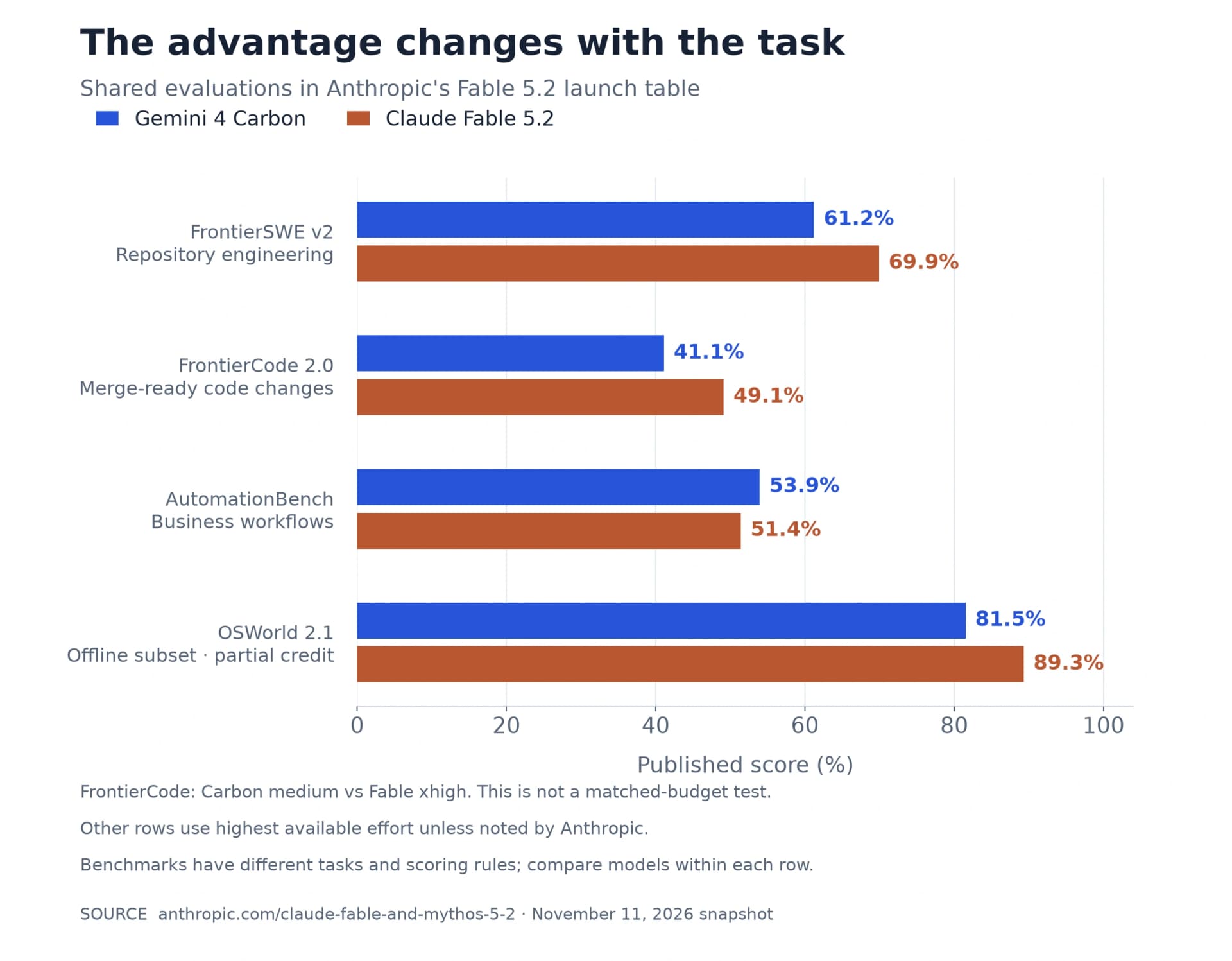
These results support prioritizing Fable for difficult repository changes and give a reason to evaluate Carbon on business workflows. Desktop operations, repository edits and business automation have different completion criteria; map each result to the work you need to deliver.
Carbon offers an attractive higher-end configuration on CursorBench
CursorBench 4.0 uses ambiguous, multi-file tasks from real Cursor sessions. Selected configurations read on November 11 were:
| Configuration | Score | Listed average cost per task |
|---|---|---|
| Carbon high | 60.4% | $9.22 |
| Carbon medium | 60.1% | $8.49 |
| Carbon low | 58.6% | $11.89 |
| Fable 5.2 max | 60.0% | $32.79 |
| Fable 5.2 high | 56.9% | $9.70 |
| Fable 5.2 medium | 54.8% | $4.66 |
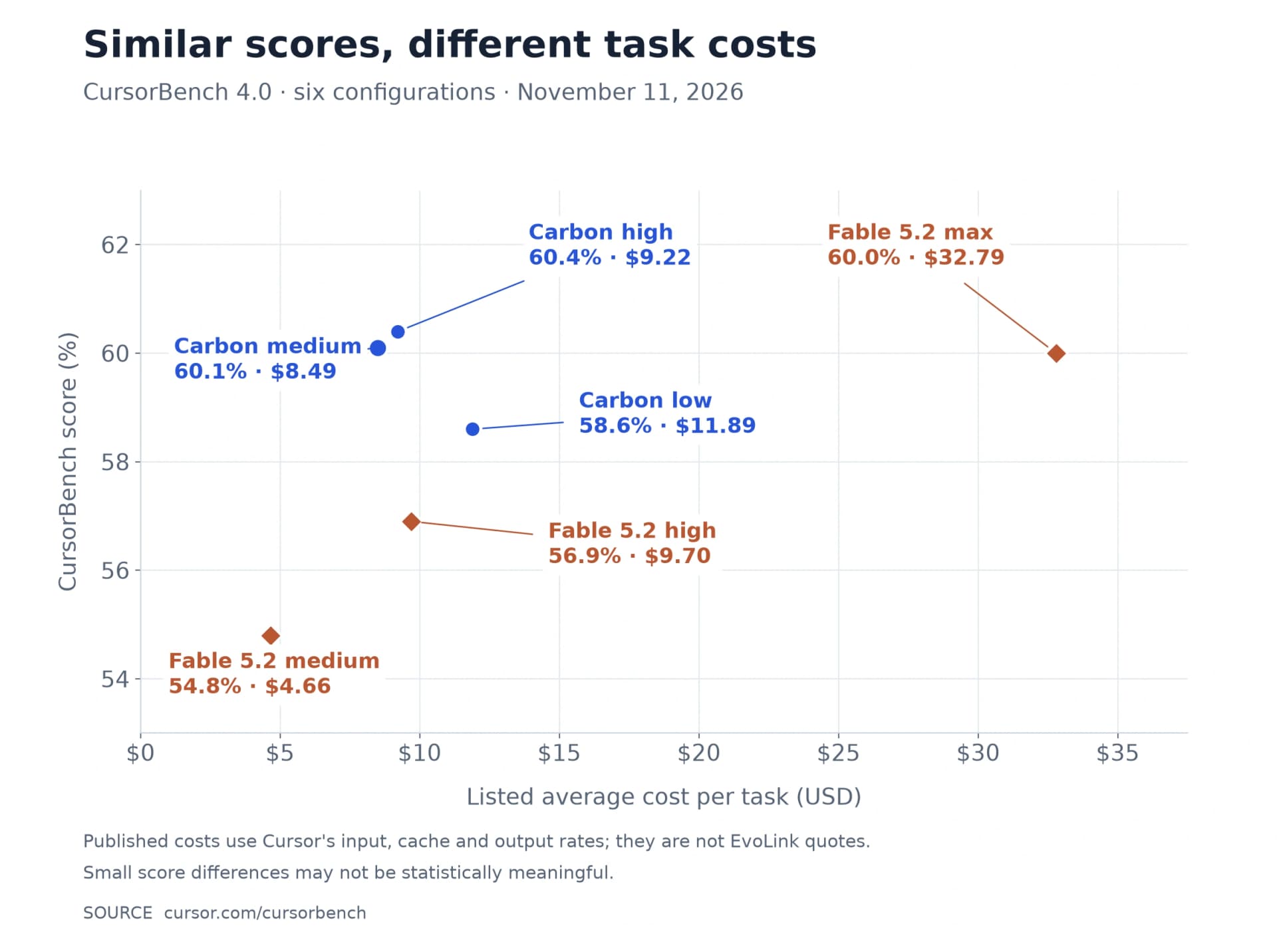
Carbon medium scores close to Fable max at a substantially lower listed cost, making it a useful first candidate for complex coding. Fable medium costs less on these tasks and also scores lower. If that quality meets your requirements, the lower Fable level may fit too.
Carbon low's average cost is higher than medium's. In a multi-step agent, reducing reasoning effort per turn can change the execution path and total usage. Choose effort by final completion and the total bill.
When is Fable's higher token price worth paying?
These are provider Standard base rates in USD per million tokens. They exclude caching, Batch, fast mode and additional paid tools.
| Model and billing period | Input | Output |
|---|---|---|
| Carbon, through November 30, 2026 | $2 | $10 |
| Carbon, from December 1, 2026 | $4 | $20 |
| Fable 5.2 | $8 | $40 |
- Carbon introductory period: $0.30.
- Carbon regular period: $0.60.
- Fable 5.2: $1.20.
Actual tasks may differ in tokenization, reasoning usage, tool calls and retries. A reason to choose Fable is that it reduces failures, manual rewrites or investigation time for a class of tasks. A reason to choose Carbon is that it meets the same acceptance criteria at a lower complete-task cost.
Start a creative-coding comparison with public projects
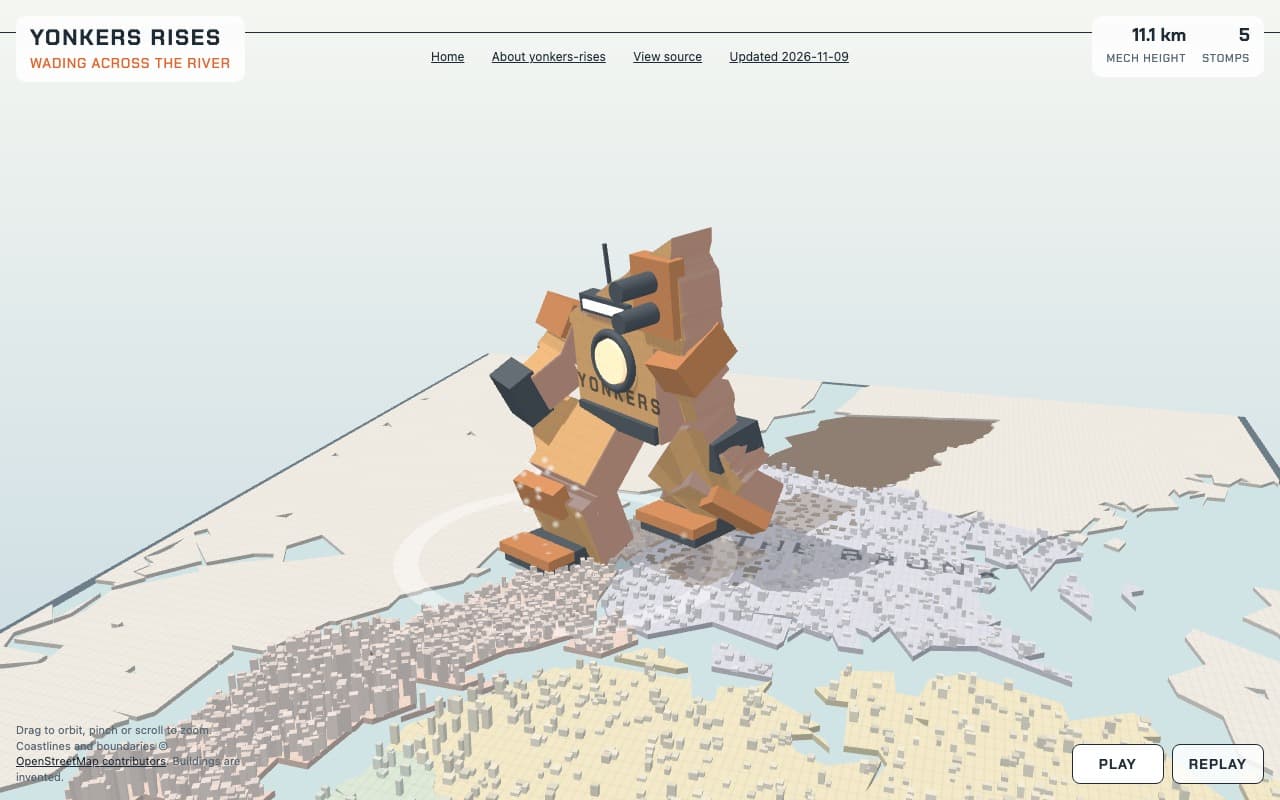

These are selected views captured from the author's public projects. Open the originals to replay the motion; the screenshots do not compare runtime speed.
When you open the demos, compare three concrete aspects:
- Geographic constraints: Check how the Yonkers outline becomes the mech and whether the map, roads and current-region labels agree. The Fable project explicitly labels its buildings as invented.
- Motion continuity: Replay the transformation, stand-up and walking sequence. Watch transitions, foot placement and contact with the ground rather than judging motion from one still image.
- Useful interaction: Try dragging, zooming and replaying in Fable, then the camera modes, chapters and speed controls in Carbon. Check whether the controls help you inspect and navigate the result.
This case helps inspect how each model handles spatial, animation and data requirements. Tool environments, prompt details and request counts differed, and there are no matched total costs or durations. It cannot establish an overall winner. The author identifies the Fable run as medium; the Carbon effort level is not specified in the account.
For an interactive prototype, give both models the same inputs. Check whether the scene meets the brief, the code runs, edits remain manageable and how many follow-up turns delivery takes. Include both the initial visual result and maintainability in acceptance.
How should you assign primary, upgrade and review models in EvoLink?
For an existing product, keep the stable primary workflow and assign identified difficult tasks to Carbon or Fable. Unified API access lets you retain your key, balance and call-management approach while expressing model choice in application configuration. Handle each model's tools and reasoning parameters according to its documentation.
Start with one of three arrangements:
/swarm and Claude Advisor also have their own product and channel conditions. With a unified API, your chosen framework or application supplies the corresponding orchestration.Use real tasks to settle the final configuration
Choose recent bug fixes, multi-file changes or tool tasks with explicit acceptance criteria. Give both models the same code revision, inputs and tool permissions.
Save four kinds of results for every task: acceptance, all model and tool costs, total time from start to delivery, and human intervention or rework. For failed tasks worth pursuing, increase effort or upgrade the model while retaining the same retry rules.
Frequently asked questions
Which should I try first on a limited budget?
For performance close to higher-end coding configurations, start with Carbon medium. If your quality requirements allow it, compare Fable medium too: it has lower cost and a lower score on CursorBench. Your own task acceptance decides.
Does Fable's higher price make it better for all coding?
Fable scores higher on some repository evaluations, while Carbon also performs strongly on the current CursorBench. Choose by task, then compare delivery and rework at different levels.
Is Carbon 75% cheaper?
Its provider base rates for uncached input and output are 75% lower during the introductory period and 50% lower afterward. That ratio is not the actual task saving and does not directly describe EvoLink account pricing.
Is setting both to medium a fair comparison?
It compares the practical behavior of those configurations, but identical level names do not mean identical compute budgets. Record model, tools, usage, duration and acceptance together.
Which is faster?
Measure first-token wait, full-response time and final task completion on your actual channel and effort settings. Thinking, tool calls and rework all affect the result.
Is changing the model name enough to switch?
Unified access reduces repeated client configuration. Tools, reasoning parameters, message formats and error handling still need model-specific checks. For handoffs, pass the necessary task material and rebuild messages for the target model.
Can I use the other model to review code directly?
Start with an independent-review trial and require a trigger and reproduction evidence for every issue. Agreement between models still needs test validation. Include review cost and time spent handling false positives in the total.