Claude Fable 5.2 Released: Coding, Reasoning and Agent Updates
Explore Claude Fable 5.2’s coding and reasoning updates, official demos, 20% lower standard token rates, effort settings and API migration considerations.
 EvoLink TeamProduct Team
On this page
The practical question is how well the model keeps longer work moving: understanding existing code, breaking down problems, using tools, checking results and adjusting after errors. A more complete answer and a project that is easier to deliver are different outcomes. The latter depends on tools, runtime, human revisions and the final bill.
Where Fable 5.2 fits in the Claude family
Fable targets difficult technical work requiring sustained reasoning. Anthropic recommends starting most workloads with the latest Opus model, moving to Fable 5.2 when evaluations at higher Opus effort still fall short.
For a style change, routine endpoint or documents organized by clear rules, a model that already succeeds may remain the economical choice. Complex dependencies, competing designs and repeated validation give a stronger model more room to help. A migration can combine data structures, business behavior, deployment and performance constraints. Avoiding one poor decision and its rework can matter more than the price of one request.
Mythos 5.2 uses the same underlying model. Fable includes cybersecurity and biology safeguards that permit broader access; Mythos is offered to organizations approved through Anthropic's verification programs. Results in those domains need to retain their specific model attribution.
A 1M context window and 128K output for longer tasks
claude-fable-5-2. It supports a 1 million token context window, 128K maximum output tokens, text and image input, and text output. Adaptive thinking is always enabled, with API effort defaulting to high.That gives a repository task room for interface definitions, implementation, tests and design history, or a research task room for several reports and their data definitions. How the materials are supplied still matters. Useful inputs establish:
- The deliverable: working code, a migration plan or a complete analysis.
- Required constraints: interface compatibility, data consistency or latency.
- Available checks: tests, type checking, builds or data validation scripts.
- Decisions the model may make and tradeoffs a person must resolve.
Clear goals and executable checks help the model recognize progress. Context capacity provides workspace; task structure determines how it gets used.
Fable 5.2 improves coding, reasoning and chart understanding
Anthropic's published results cover several parts of technical work. The chart below compares FrontierCode 2.0, FrontierSWE v2, Humanity's Last Exam with tools, and Chartography without tools.
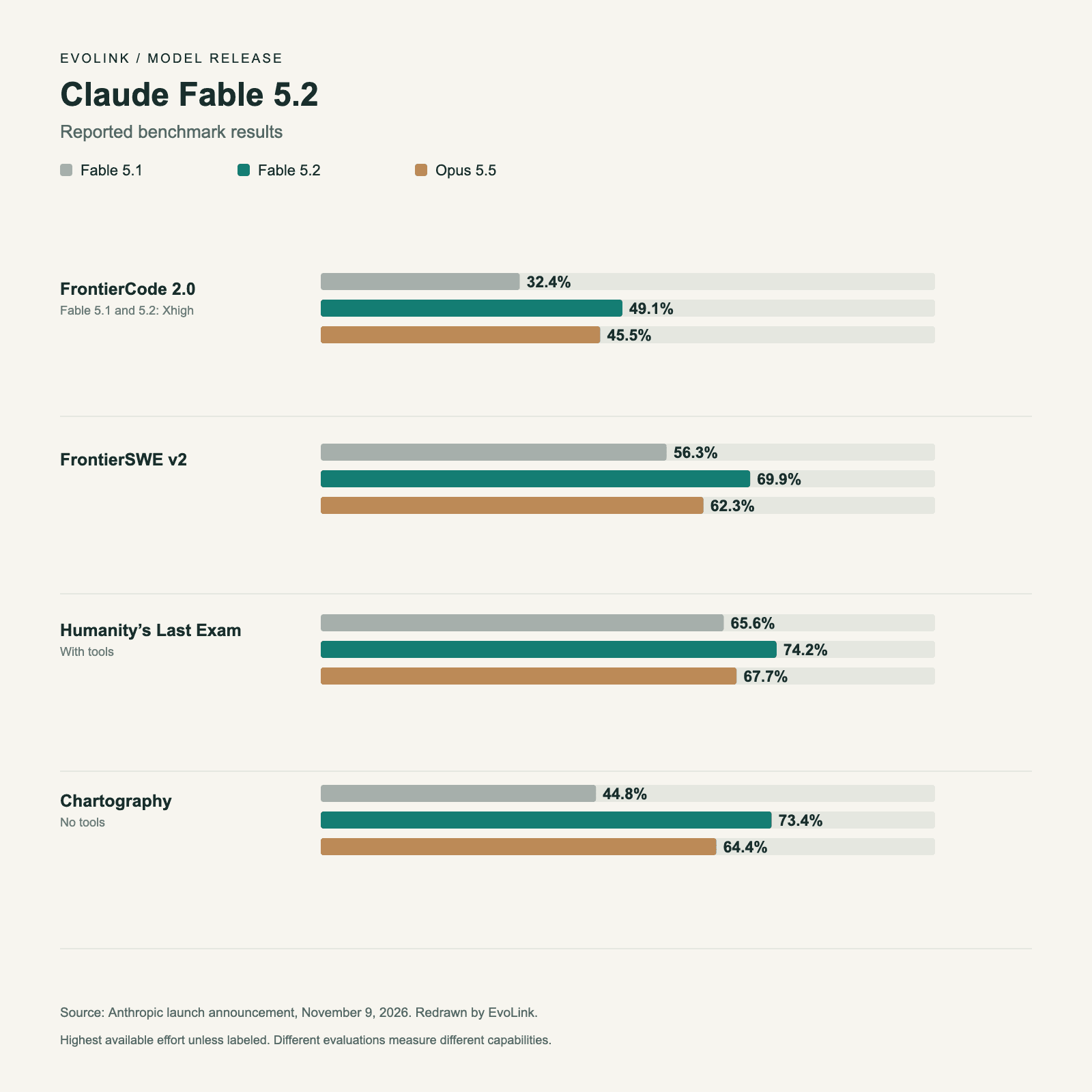
Coding, multistep analysis and extracting information from charts often meet in one project. A developer might supply performance curves and error logs to locate a bottleneck; a researcher might read a chart and write code to test an explanation; a product team might turn visual references into an interactive interface.
Evaluate with the inputs your team actually uses. If those include screenshots, charts and code, include all three. One text-only prompt can miss meaningful workflow differences.
Hardware prototypes show engineering across several stages
Anthropic and Diode asked Fable 5.2 to design a USB speakerphone, a home voice-assistant hub and a handheld virtual pet. The model worked through specifications, schematics, component placement, PCB routing, enclosures and firmware. Diode engineers manufactured and tested the devices; Anthropic reports all three worked without fixes to their circuitry.
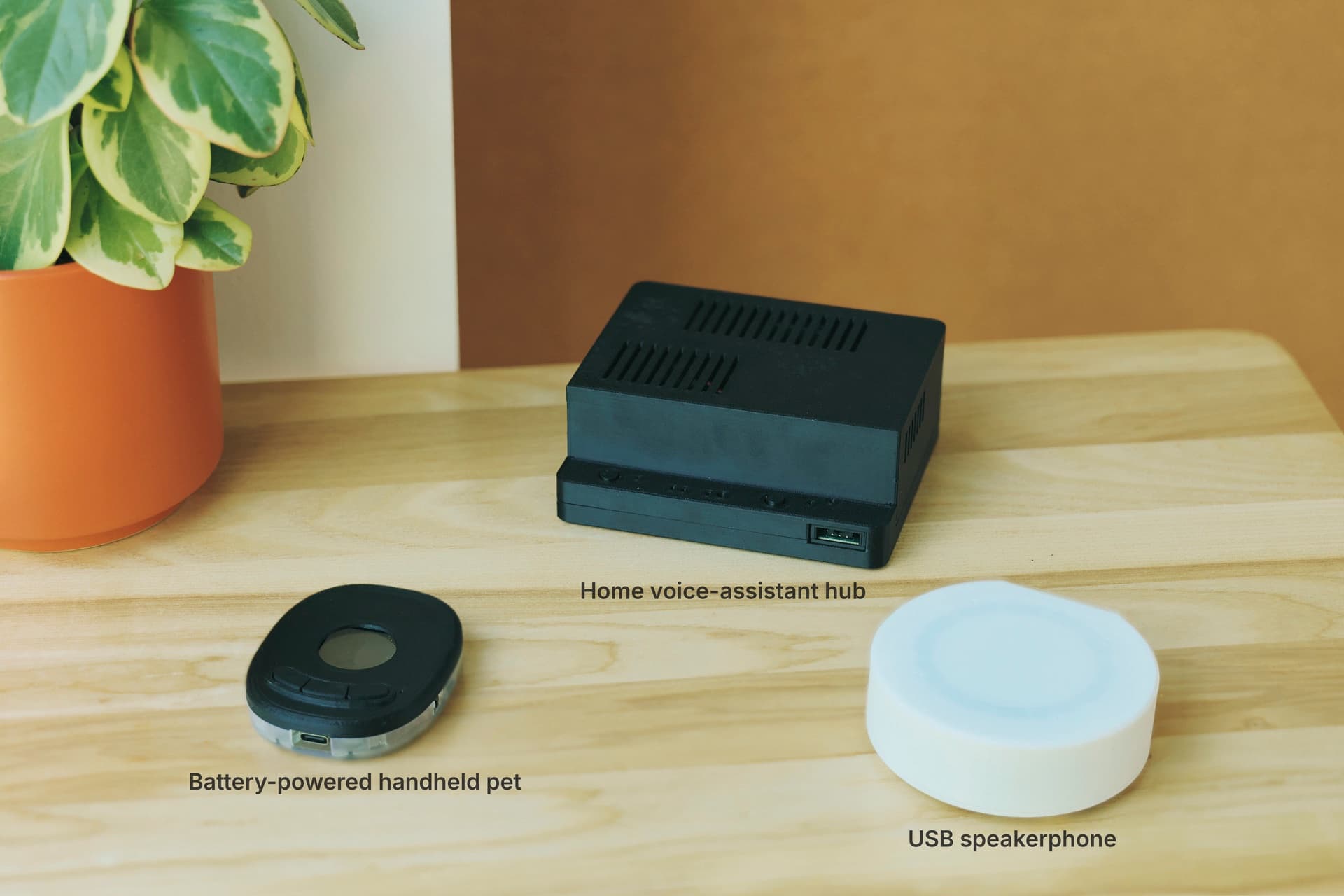
Component placement affects routing, connectors affect enclosure openings, and assembly affects mechanical design. A locally reasonable choice can cause a later failure. The case illustrates the value of tracking constraints and downstream consequences throughout a project.
These are prototypes. Electrical validation, antenna tuning, thermal testing and certification remain, and the designs are not ready for mass production. The achievement is a working prototype; further product engineering is still needed. Software teams can ask a similar question: did the model consider deployment, monitoring, rollback and maintenance alongside runnable code?
A 1,000-agent experiment explores long-running collaboration
The interesting systems question is how agents claim dependent tasks, share progress, submit results and combine local contributions. Shared task state and reliable checks help work continue. In a large migration, execution units need common interfaces, coordination to avoid duplicate edits and unified tests. Research subtasks similarly need consistent data definitions if their analyses are to fit together.
Start with subtasks that can be completed independently and checked clearly before increasing the number of agents. Concurrency adds coordination costs; useful task boundaries matter as much as agent count.
Games and interactive demos make the capabilities visible

The appeal is sustained production work: turning characters, a story and a goal into code, asset-tool calls and testing. Teams making educational tools, interactive demos or brand experiences could try an adjustable product explanation or an operable process simulation to check whether an idea is understandable.
Assess interaction feedback, stability and ease of modification alongside appearance. Prototypes receive repeated changes; an editable source tree and clear asset organization affect what those revisions cost.
Standard rates fall 20%; Fast mode offers a speed tradeoff
Anthropic's published standard rates are 20% below Fable 5.1:
| USD per million tokens | Fable 5.1 standard | Fable 5.2 standard | Fable 5.2 Fast mode |
|---|---|---|---|
| Input | $10 | $8 | $16 |
| Output | $50 | $40 | $80 |
Fast mode may be useful when waiting has a cost, such as interactive debugging. For queued background work, test whether the saved time justifies the higher rate.
Caching and the complete task bill still matter
An agent can reuse the same project background and tool definitions across requests. Where cache conditions are met, those tokens are billed differently from ordinary input. Large cache-read usage in the game account is another reason to separate token categories.
Record ordinary input, cache writes, cache reads and output separately, then add external tool fees and human rework when evaluating an accepted deliverable. Lower unit rates improve the base calculation; how the task runs determines the final saving.
Effort is part of model selection
low, medium, high, xhigh and max, with the API defaulting to high. Anthropic recommends starting at High, trying Xhigh after measuring gains on difficult tasks, and reserving Max for exploring capability limits or unusual work where time and tokens are secondary.Artificial Analysis results checked on November 10, 2026 include:
| Configuration | Intelligence Index | Weighted evaluation cost per task |
|---|---|---|
| Medium | 56 | $3.80 |
| High | 62 | $9.08 |
| Max | 65 | $26.54 |
These are Default Fallback configurations and AA's evaluation workload and cost methodology, rather than quotes for a typical user task. High to Max improves the score in this snapshot and increases evaluation spend substantially.
Keep inputs, tools and acceptance criteria fixed while adjusting effort. Find the first setting that meets requirements and check whether more budget improves the actual result. Routine information organization and a migration with complex dependencies can warrant different settings.
Revisit old prompts when upgrading
Anthropic's prompting guide notes that standing instructions to use more subagents can cause unnecessary delegation. Large token budgets written into a prompt can also affect consumption: removing such wording reduced cost with similar performance in some coding tests. That observation concerns textual budgets, rather than the API's task budgets feature.
Review whether every task needs parallel work, exhaustive alternatives or accumulated duplicate rules. Clear completion conditions make work easier to assess. Keep the original prompt and test changes individually against quality, spend and execution behavior, so that model effects and workflow effects can be distinguished.
What production integrations should check
Official channels include the Claude API, Amazon Bedrock, Google Cloud, Microsoft Foundry and Claude Platform on AWS. Channel-specific model IDs, features and billing should be checked in their own documentation.
Existing integrations should check four changes:
- Conversation history: changing the system prompt, tools or earlier messages can invalidate returned thinking blocks. The prefix check applies to every account; leaving
prefix_mismatch_behaviorunset when resubmitting an invalid block produces a 400 error. - Switching models: on the Claude API, moving a conversation from Fable 5.2 to Opus 5.5 drops Fable's thinking blocks, although the request can succeed.
- Computer use: the old
computer_20251124tool needs migration to the newer tool set, except on Amazon Bedrock. - Advisor: a Fable 5.2 executor needs a compatible Fable 5.2 or Mythos 5.2 advisor.
When managing models through a unified API gateway, check the route's parameter forwarding, billing and handling of history during long conversations. Those details directly affect production workflows.
Which teams should evaluate Fable 5.2 first?
Fable 5.1 users can start with jobs that already have quality and cost records, measuring completion, revisions and spend. Opus users can start with recurring difficult work: code that still fails tests after several fixes, or plans that repeatedly miss interdependent constraints.
Agent product teams can evaluate Fable for planning, difficult analysis and critical review while assigning well-defined execution steps to more economical models. Measure information handoffs and the full bill before adopting that division of work.
A practical starting set is one routine task, one known hard problem and one longer project. Compare deliverable quality, elapsed time, total spend and human changes, then choose a default model, an escalation rule and effort settings. Fable 5.2 offers a higher capability ceiling and lower standard token rates; familiar tasks reveal where those changes lead to reliable, affordable delivery.
Frequently asked questions
When was Claude Fable 5.2 released, and what changed from Fable 5.1?
Does the Fable 5.2 release mean I should replace Opus 5.5?
What is the difference between Fable 5.2 and Mythos 5.2?
How does the 20% price cut from Fable 5.1 affect task cost?
Can Fable 5.2 generate images or videos directly?
What do the 1M context and 128K output limits mean for longer tasks?
Which access channels are listed for the Fable 5.2 release?
claude-fable-5-2; official channels also include Amazon Bedrock, Google Cloud, Microsoft Foundry and Claude Platform on AWS. Check each channel's identifiers, feature support and billing before integration. For EvoLink, use the Fable 5.2 model page to check current integration details and rates; third-party routes need their own parameter and history compatibility checks. Official availabilityWhich effort setting should I start with?
high; available levels are low, medium, high, xhigh and max. Start with High and compare other levels against the same inputs, tools and acceptance criteria. Try Xhigh after measuring a benefit on difficult tasks, and use Max when exploring capability limits justifies the additional time and tokens. Effort guidanceWhy might an existing conversation return a 400 error after upgrading?
prefix_mismatch_behavior unset returns 400. Review thinking-history handling and the documented prefix-mismatch behavior during migration. Separately, switching from Fable 5.2 to Opus 5.5 on the Claude API can discard thinking blocks while the request still succeeds. Migration changes