

MiniMax H3 Max vs MiniMax H3: Which Model Should You Use?

For EvoLink users, the strongest default is workload routing rather than a family-wide winner. Put reversible drafts and variant generation on H3 Max, send control-heavy or 2K briefs to H3, and keep a tested cross-provider fallback for critical queues.
Test the two routes with the same brief: open MiniMax H3 Max, open MiniMax H3, or review all options on the Hailuo family page.
H3 Max vs H3: The Decision in One Table
The comparison below describes the routes currently available through EvoLink on September 3, 2026. It separates contract facts from quality questions that still require workload testing.
| Decision area | MiniMax H3 Max | MiniMax H3 | Choose based on |
|---|---|---|---|
| Primary role | Fast prompt-led and keyframe-led iteration | General-purpose H3 production with broader controls | Throughput versus control surface |
| EvoLink model IDs | minimax-h3-max-text-to-video, minimax-h3-max-image-to-video | minimax-h3-text-to-video, minimax-h3-image-to-video, minimax-h3-reference-to-video | Input contract |
| Input modes | Text; first frame; last frame; first + last frame | Text; first/last frame; general image, video, and audio references | Brief complexity |
| Resolution | 480p or 768p | 768p or 2K | Draft/review versus higher-resolution delivery |
| Duration | 5–15 seconds | 4–15 seconds | Whether a 4-second shot is required |
| Text-to-video ratios | Six fixed ratios | Six fixed ratios | Delivery channel |
| I2V ratio | Follows input frame | Follows input frame | Keyframe preparation |
| Reference-to-video | Not exposed on EvoLink's current H3 Max routes | Dedicated reference route | Identity, motion, performance, or audio guidance |
| Open weights | Do not infer from base H3 | Official H3 weights are available | Hosted API versus local/self-hosted research |
| Billing shape | Per output second; separate 480p/768p tiers | Per output second; reference inputs can add billable units | Cost per accepted clip |
| Best starting use | Ad variants, social clips, ecommerce motion, storyboard tests | 2K finals, multi-reference continuity, complex creative direction | The acceptance gate |
What MiniMax H3 Max Changes
MiniMax-H3-Max as a fast H3 generation model and lists it in the Video Generation V2 API. Its documented input and output contract explains why H3 Max should be understood as a focused serving and generation route rather than a complete replacement for every H3 capability.The practical change is a speed-oriented surface with fewer input modes:
- 480p and 768p output instead of an H3 2K tier.
- Prompt-only or first/last-frame workflows instead of the full H3 reference pack.
- A 5-second minimum rather than H3's 4-second minimum.
- Two EvoLink model IDs instead of three.
Those constraints can be an advantage when the product only needs rapid short-form generation. A smaller contract is easier to validate, and faster iteration can reduce the time between creative idea, review, and the next attempt.
When H3 Max Is the Better Route
High-volume ad variants
H3 Max is a strong candidate when a campaign needs many combinations of hook, composition, camera move, product angle, and ending. Generate at 480p while eliminating weak concepts, then move accepted directions to 768p. Judge the route on accepted ads per dollar and reviewer hour, not on a single showcase clip.
Ecommerce product motion
Start from a prepared product frame and use explicit motion language: what moves, what must remain fixed, how the camera behaves, and where the clip should end. First-and-last-frame input can define a product reveal or transformation more tightly than a prompt alone.
The acceptance rubric should include logo integrity, silhouette, color, material texture, background stability, and whether the final composition leaves room for copy or UI overlays.
Social and storyboard iteration
For 9:16, 1:1, and 16:9 variants, H3 Max can act as an idea-validation lane. The purpose is to answer “does this shot work?” before spending more on a higher-resolution or more heavily controlled generation.
Reversible product features
Use H3 Max first when a failed output is cheap to detect and retry: background loops, short transitions, alternate camera moves, thumbnail motion, or previsualization. Do not make it the automatic first route for regulated, identity-sensitive, or expensive review workflows until it passes a stricter gate.
When MiniMax H3 Is the Better Route
You need 2K output
H3 is the family route on EvoLink with a 2K output tier. If 768p cannot meet the delivery requirement, the route decision is already made. Do not generate at H3 Max and assume a later upscale recreates detail or corrects temporal artifacts.
You need broader references
H3 exposes a separate reference-to-video model ID. The EvoLink contract supports up to nine reference images, three reference videos, and three reference audio clips, capped at 12 files total. Those assets can carry character appearance, environment, motion, performance, voice, or soundtrack context.
image_urls, video_urls, or audio_urls. A first or last frame is a boundary condition, not a substitute for a reference pack.You need a 4-second shot
H3 supports integer durations from 4 through 15 seconds. H3 Max begins at 5 seconds. This can matter when a fixed edit, ad slot, or UI transition requires a precise 4-second asset.
You need open weights
MiniMax released the base H3 weights. That makes H3 relevant for research, local workflows, and teams evaluating self-hosted deployment. Do not transfer that status to H3 Max without a separate artifact and license.
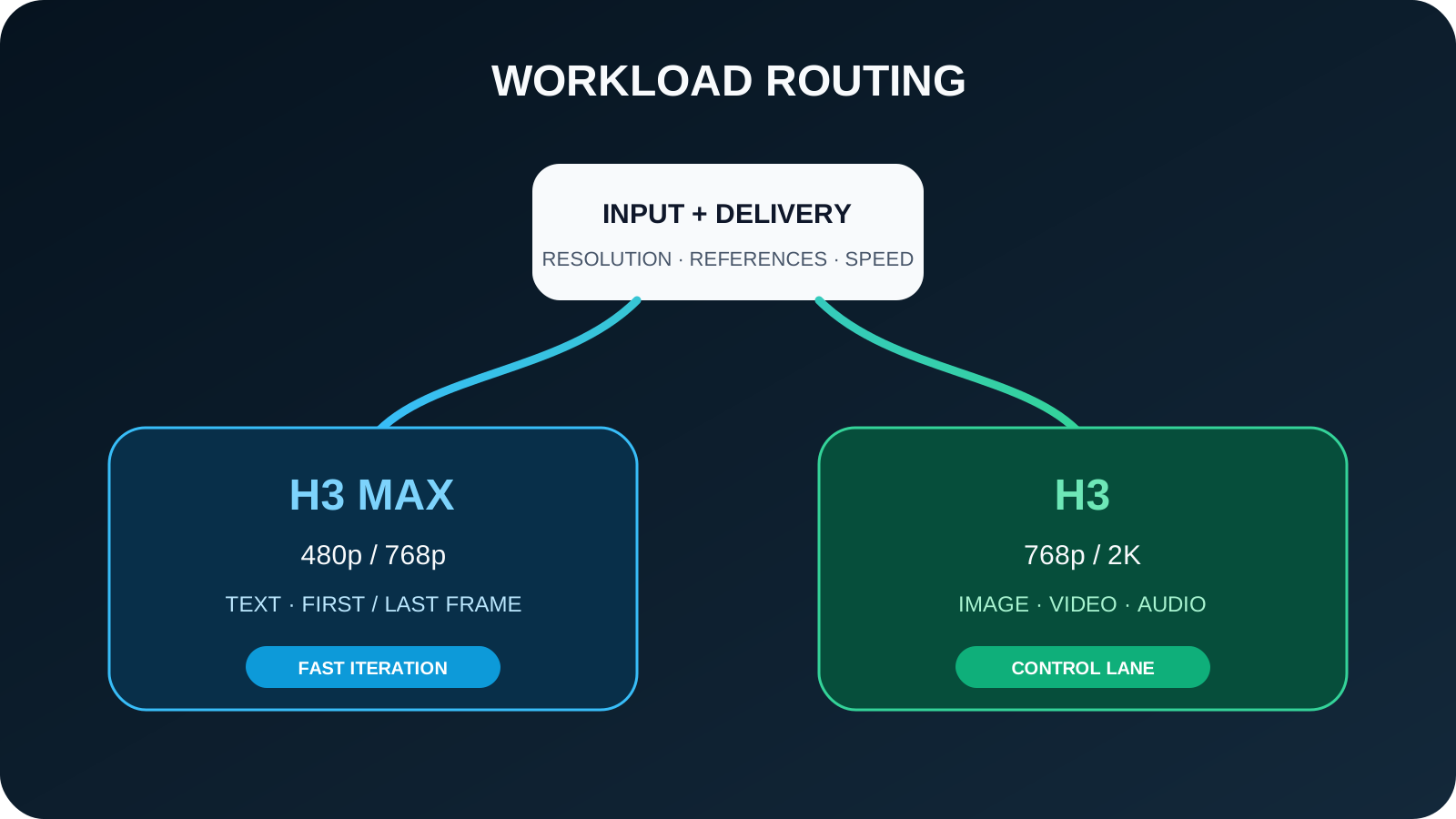
Route by Workload, Not by Model Name
| Workload | Start with | Escalate or switch when | Acceptance metrics |
|---|---|---|---|
| Ad concept batch | H3 Max 480p | Direction passes; regenerate at 768p or use H3 for 2K | Hook clarity, product fidelity, first-pass approval |
| Ecommerce I2V | H3 Max I2V | Identity or material consistency needs broader references | Shape, logo, texture, start/end accuracy |
| Social short | H3 Max | Delivery requires 2K or reference-led continuity | Motion, safe crop, pacing, artifact rate |
| Storyboard/previs | H3 Max 480p | Selected shot moves to final-quality production | Decision speed, reviewer minutes, accepted concepts |
| Character continuity | H3 reference-to-video | A simpler first/last-frame constraint is sufficient | Face, costume, voice, environment consistency |
| Performance transfer | H3 reference-to-video | Never default to H3 Max without an equivalent input | Motion match, timing, audio alignment |
| 2K final | H3 | Delivery requirement drops to 768p | Final-frame quality, temporal stability, edit readiness |
| High-availability queue | Primary route by workload | Error, queue, moderation, or quality threshold fails | Successful tasks, time to accepted result, fallback recovery |
Compare Cost per Accepted Clip
H3 Max and H3 use different output tiers and input contracts, so headline per-second prices are not a complete comparison. Keep live prices on the model pages and calculate with the rates shown for the account at test time.
cost per accepted clip =
  (generation cost + retry cost + fallback cost + review cost)
  / accepted clips
For a fair test:
- Freeze the prompt, input assets, duration, output tier, and review rubric where the contracts overlap.
- Run enough attempts to expose variance; one clip per model is not evidence.
- Record task creation time, completion time, status, billed units, retry reason, and reviewer outcome.
- Separate route incompatibility from model-quality failure.
- Compare the time and cost required to reach an accepted asset.
H3 Max may generate faster, yet lose the workflow if it needs more retries or cannot accept the references that make the brief reliable. H3 may cost more per attempt, yet win when its inputs remove review cycles. The result is workload-specific.
A Production Rollout Plan
1. Segment the queue
fast-draft, keyframe-iteration, 2k-final, and reference-led. Do not scatter raw model IDs across application code. Keep the routing policy in configuration so it can change without a deployment-wide rewrite.2. Build a matched evaluation set
Include at least 20 representative jobs across prompts, first-frame, last-frame, and first-and-last-frame cases. Add 2K and reference-heavy jobs to prove that routing rules correctly keep them on H3.
3. Define gates before testing
Choose minimum acceptance rate, maximum cost per accepted clip, maximum queue time, and artifact stop conditions. If a rule is created after seeing results, it can easily become a justification rather than a test.
4. Shadow and canary
Send a small eligible slice to H3 Max while the existing production path remains available. Compare outcome logs, then increase traffic only for task classes that pass. Keep the H3 and cross-provider fallbacks callable.
5. Preserve input-aware fallback
A fallback must understand the request. An H3 Max first/last-frame request may map to H3 I2V, but a general H3 reference request cannot map backward to H3 Max without losing inputs. Reject or transform intentionally; never drop reference fields silently.
Common H3 Max vs H3 Mistakes
| Mistake | Why it fails | Better policy |
|---|---|---|
Treat Max as a universal upgrade | H3 retains 2K, broader references, and open weights | Route by required controls |
| Copy another endpoint's capabilities to EvoLink | Provider surfaces can differ | Validate EvoLink's current two-route contract |
| Compare 480p H3 Max with 2K H3 as if only speed changed | Output tiers and review purpose differ | Match settings or label the tradeoff |
| Route every job through the faster model first | Some jobs are incompatible by definition | Pre-classify 2K and reference-heavy work |
| Compare list price only | Retries and review work can dominate | Track cost per accepted clip |
| Hard-code model IDs in feature code | Rollback becomes slow and risky | Use a routing configuration |
| Drop unsupported inputs during fallback | The generated result no longer represents the brief | Preserve semantics or fail clearly |
Recommended EvoLink Policy
Frequently Asked Questions
Is H3 Max better than MiniMax H3?
Not universally. H3 Max is better aligned with fast 480p/768p prompt and keyframe iteration. H3 is better aligned with 2K and multimodal reference workflows.
Why is H3 Max limited to 768p while H3 supports 2K?
They expose different route contracts and optimize for different jobs. H3 Max's current EvoLink contract prioritizes 480p/768p iteration; H3 keeps the higher-resolution tier.
Can both models use first and last frames?
Yes. Both have image-to-video routes that accept a first frame, a last frame, or both. The output follows the input-frame ratio.
Which model supports reference video and audio?
MiniMax H3. Its reference-to-video route accepts general image, video, and audio references. EvoLink's current H3 Max routes do not.
Which model should I use for batch advertising creative?
Begin with H3 Max for compatible 480p/768p variants, then route selected or control-heavy briefs to H3. Validate with accepted ads per dollar and reviewer hour.
Are H3 Max and H3 priced the same?
Do not assume so. They have different output tiers and billing inputs. Check each model page's live rate and compare the total cost required to reach an accepted clip.
Is H3 Max open source?
Do not infer that from H3. MiniMax H3 has official open weights; H3 Max needs its own published artifact and license before it should be described that way.
Can I switch models without changing the API host?
Yes. EvoLink uses one video-generation host and shared task flow, but the model ID and supported fields still need to match the chosen route.
What is the safest production default?
Default compatible draft and variant jobs to H3 Max, pre-route 2K/reference-heavy work to H3, and maintain an independent fallback. Promote traffic by measured acceptance and reliability.
Sources and Verification Scope
- MiniMax official Video Generation V2 documentation
- MiniMax official model catalog
- MiniMax H3 release
- MiniMax H3 open-weight announcement
- EvoLink MiniMax H3 Max model page
- EvoLink MiniMax H3 model page


