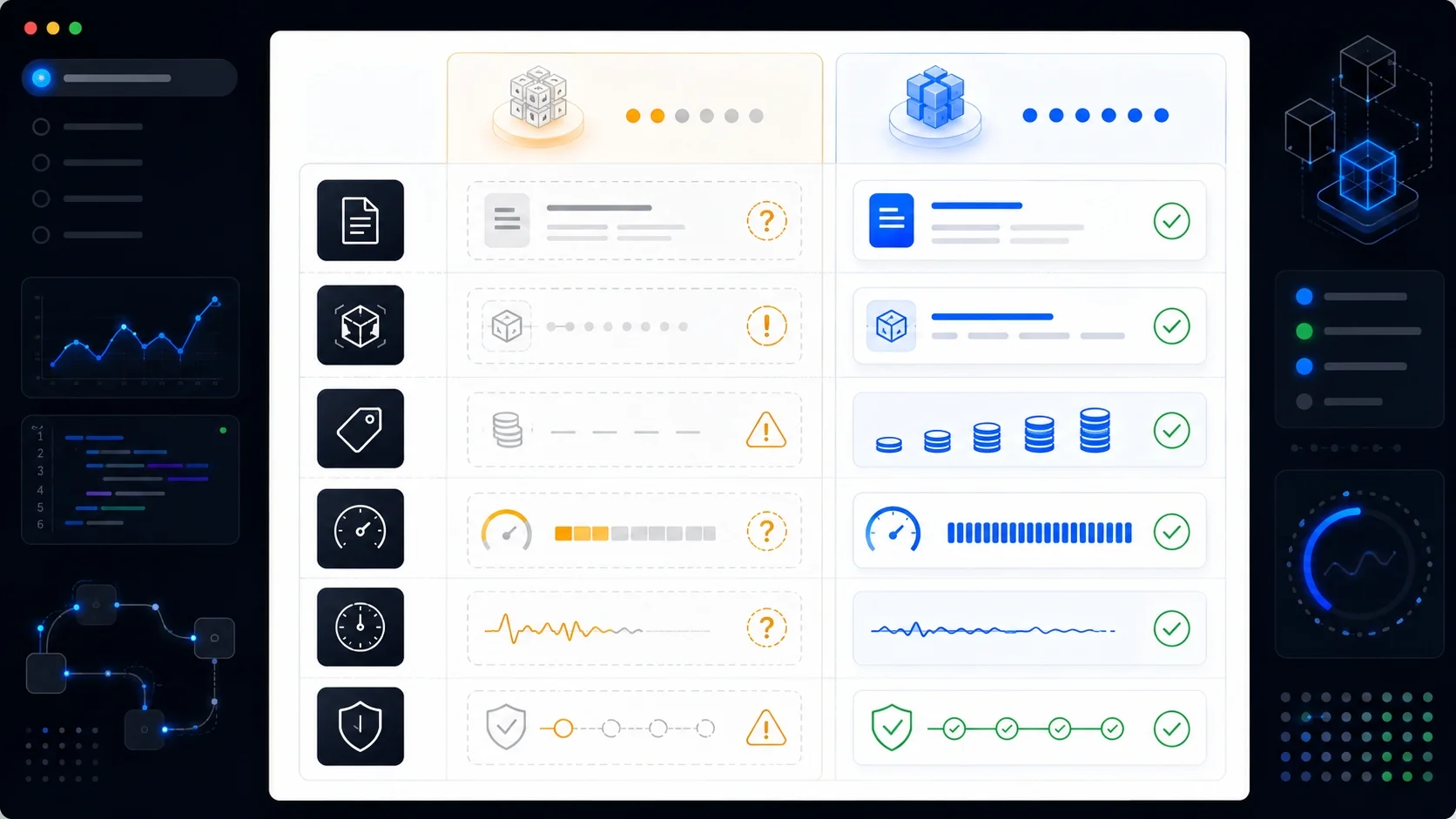
Gemini Omni vs Veo 3.1: Build on Veo or Wait?

TL;DR
- Veo 3.1 is the safer developer baseline today because Google documents it through official API routes.
- Gemini Omni may become important, especially if Google exposes chat-based editing, remixing, or a stronger unified video workflow.
- Do not compare Gemini Omni and Veo 3.1 as if both are equally documented public APIs.
- The right question is not "Which model wins?" It is "Which route has enough public evidence for production planning?"
- Until Google publishes official Gemini Omni API docs, treat Gemini Omni as a watch item before Google I/O 2026.
Quick answer: build on Veo or wait for Omni?
That answer may change if Google publishes:
- a public Gemini Omni model ID
- Gemini API or Vertex AI documentation
- pricing
- quota and rate limits
- supported video editing or remix endpoints
- commercial usage terms
Until then, Veo 3.1 and Gemini Omni should not be treated as equivalent developer choices.
Gemini Omni: the unresolved relationship signal
Gemini Omni is a reported Google video-generation model or feature that surfaced in Gemini-related UI signals before Google I/O 2026.
Third-party reports describe language such as creating with Gemini Omni, remixing videos, editing directly in chat, and trying templates. That is highly relevant for developers because chat-based video editing could change how teams build creative tools.
But the current public evidence does not answer the key API questions:
- Is Gemini Omni a standalone model?
- Is it a Gemini app product layer?
- Is it backed by Veo?
- Is it available through Gemini API or Vertex AI?
- Is it a public route or an internal consumer experience?
Until Google answers those questions, Gemini Omni is not a stable production target.
Veo 3.1: the documented Google video baseline
Veo 3.1 is Google's documented video-generation model family.
The official Google materials reviewed for this article document Veo 3.1 through developer-facing routes, including Gemini API and Vertex AI. Google also describes current Veo 3.1 capabilities such as text-to-video, image-to-video, first-and-last-frame workflows, prompt rewriting, and video-generation controls depending on the route and release stage.
That does not mean every Veo 3.1 route is simple. Teams still need to verify:
- access path
- release stage
- pricing
- quota
- supported resolution
- clip duration
- audio support
- whether the feature is preview, paid preview, or generally available
But compared with Gemini Omni, Veo 3.1 has a much clearer developer evidence trail.
API readiness matrix
| Dimension | Gemini Omni | Veo 3.1 |
|---|---|---|
| Current status | Reported through UI signals and third-party coverage | Officially documented Google video model family |
| API docs | Not publicly documented yet | Documented through Google Gemini API / Vertex AI |
| Public model ID | Not confirmed | Public Veo 3.1 model paths exist |
| Pricing clarity | Not published for Gemini Omni | More concrete through Google pricing and API docs |
| Production readiness | Unknown | More practical baseline |
| Developer risk | High until official docs exist | Lower, but still depends on quota, pricing, and access |
| Best current use | Watch item | Build and evaluate today |
The key point is not that Veo 3.1 will always be better. It is that Veo 3.1 is the option a developer can currently evaluate against public documentation.
Is Gemini Omni replacing Veo?
Nobody outside Google's official product and developer teams can answer that yet.
There are three plausible interpretations:
| Possible interpretation | What it would mean | Developer implication |
|---|---|---|
| Gemini consumer UI brand | Omni is the Gemini app name for a new video experience | API may still use Veo model names |
| Veo-backed Gemini experience | Omni is a product layer or extension on top of Veo | Veo remains the developer baseline until docs change |
| New Gemini-native video model | Omni is a new model family with its own architecture and API | Developers should wait for model ID, pricing, and docs |
This is why a hard headline like "Gemini Omni replaces Veo" is risky. It collapses several different product possibilities into one unsupported claim.
What developers should compare instead of demo hype
Early Gemini Omni demos may be impressive, but demo quality is not enough for production planning.
A developer comparison should focus on these questions:
- API availability: Can my application call the model through a documented endpoint?
- Model ID: Is the identifier public, stable, and documented?
- Pricing: Is the billing unit clear enough for customer-facing cost estimates?
- Quota: Can the route handle batch or production traffic?
- Latency: Does the generation time fit the workflow?
- Failure behavior: Can my app retry or fall back safely?
- Editing capability: Are remix, object swap, or chat edits exposed through API, or only the app?
- Commercial terms: Can generated outputs be used in the intended setting?
On those criteria, Veo 3.1 is currently more concrete. Gemini Omni may become more interesting if Google exposes its reported editing and remixing strengths through public APIs.
When Veo 3.1 is the safer choice
Veo 3.1 is the safer choice if your team needs:
- a documented Google video model path
- a baseline for text-to-video or image-to-video evaluation
- a way to test current Google video quality before I/O
- clearer pricing and quota research
- an implementation plan that does not depend on unconfirmed product names
That does not make Veo 3.1 risk-free. Preview stages, quota limitations, regional availability, and route-specific pricing can still matter. But those are normal API evaluation questions, not rumor-resolution questions.
When Gemini Omni could become the better route
Gemini Omni would become materially important for developers if Google publishes evidence that it offers one or more of these through a public API:
- stronger chat-based video editing
- object replacement or scene remixing
- unified text, image, video, and audio workflows
- better prompt adherence than current Google video routes
- competitive pricing
- reliable quota for production use
- a clean migration path from Veo-based workflows
Until then, Gemini Omni is best treated as a likely Google video direction, not a route your application can depend on.
Build timing: what teams should do now
For product teams, the best response is not to wait passively. It is to make your video stack model-flexible.
Use an internal interface that can route video jobs across models:
- create generation request
- attach reference assets
- submit job
- poll or receive callback
- store output and metadata
- record cost, latency, error type, and model version
This gives you three advantages:
- You can build today on documented routes like Veo 3.1.
- You can compare Gemini Omni quickly if it becomes public.
- You avoid rewriting product code around every new Google video announcement.
That is the real advantage of a unified API strategy: new model releases become evaluation work, not migration emergencies.
Search controversies to watch
The Gemini Omni search results are likely to stay volatile around Google I/O 2026.
| Search controversy | Why it matters | EvoLink's current position |
|---|---|---|
| Is Omni a new model or a Veo wrapper? | It affects whether developers should expect new APIs or only a Gemini UI update | Not confirmed; list both possibilities |
| Is Omni better than Veo 3.1? | Early demos are not benchmarks | Do not make winner claims yet |
| Is Omni replacing Veo? | Product branding and API naming may diverge | Wait for official docs |
| Does Omni have pricing? | Pricing queries will attract thin pages | Treat pricing as unpublished until official |
| Can Omni be used in production? | Developers need quota, terms, and endpoints | Not enough public evidence yet |
If Google announces Gemini Omni at I/O, the first update should not be a "winner" headline. It should be a documentation audit.
Decision framework
| If your team needs... | Start with | Why |
|---|---|---|
| A Google video route you can evaluate now | Veo 3.1 | It has official developer documentation |
| A watchlist for future Google video editing | Gemini Omni | Early reports point to remix and chat-editing workflows |
| Production planning | Veo 3.1 plus abstraction | You can build now and keep room to switch |
| A post-I/O update plan | Gemini Omni checklist | Model ID, pricing, quota, and docs will decide the next step |
Compare available routes before waiting
If your team needs to ship video generation now, compare documented video routes first. Then treat Gemini Omni as a future candidate if Google turns it into a public developer route.
Evaluate Veo 3.1 on EvoLinkFAQ
Is Gemini Omni better than Veo 3.1?
There is not enough official evidence to make that claim. Early demos and third-party reports are useful signals, but they are not controlled benchmarks or public API documentation.
Is Gemini Omni replacing Veo?
Not officially. Gemini Omni could be a new model, a Gemini app product layer, or a Veo-backed experience. Developers should wait for Google documentation before treating it as a replacement.
Does Gemini Omni have an API?
Can developers use Veo 3.1 today?
Veo 3.1 has a clearer official developer path through Google documentation. Teams still need to check access, release stage, quota, pricing, and route-specific capabilities before production use.
Should teams wait for Gemini Omni before building video generation?
Usually no. If you need video generation now, build against documented routes and keep your model layer flexible so Gemini Omni can be evaluated later.
What would make Gemini Omni production-ready?
A public model ID, API endpoint, pricing, quota, rate limits, supported modalities, usage terms, and enough reliability data for real workloads.
Is Gemini Omni pricing available?
No official public Gemini Omni API pricing was found in the sources reviewed for this article.
How should teams compare Google video models?
Compare API availability, pricing, quota, latency, failure behavior, editing controls, input/output support, and commercial terms. Avoid comparing leaked demos against documented APIs as if they were the same evidence class.